64% of venture money now goes to AI. What it means if you're raising in 2026
Q3 2026 venture data: AI took $102B of $159B, 27 companies took a third of all capital, and per-seat SaaS got repriced. What founders should change before a raise.
In Q3 2026 startups worldwide raised $159B. $102B of it, 64%, went to AI companies, according to Crunchbase data published on October 5. Two more trends sit under that number: capital is concentrating in a few dozen companies, and classic per-seat SaaS has been repriced.
Many of my contacts are founders and VCs, and fundraising is the topic I follow most closely. For a while I’ve watched money move from traditional software and SaaS into AI. Below is what the data says about that shift, where the picture breaks, and four moves for a founder raising outside the top tier.
01 · AI’s share peaked in Q1 and is still two thirds of all venture money
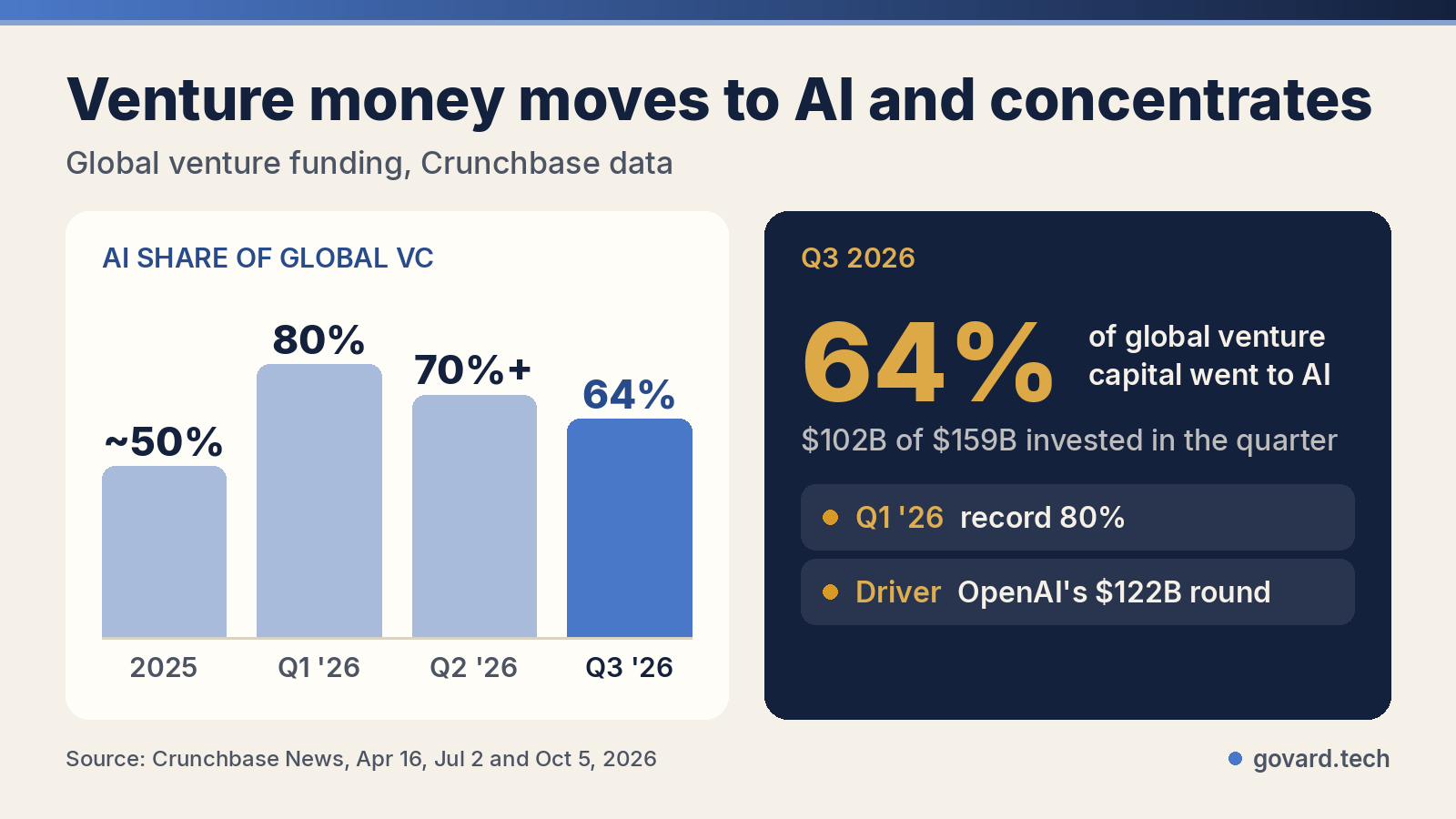
From Q4 2024 through 2025, AI took about half of global venture funding. In Q1 2026 its share jumped to 80%. Crunchbase attributes the spike to OpenAI’s record round and “a small handful of other enormous deals”. In Q2 the share stayed above 70%, and in Q3 it settled at 64%.
The dip from 80% to 64% is a return from one exceptional quarter. Two thirds of all venture dollars still go to a single technology category.
02 · Volume cooled after the record, and capital concentrated
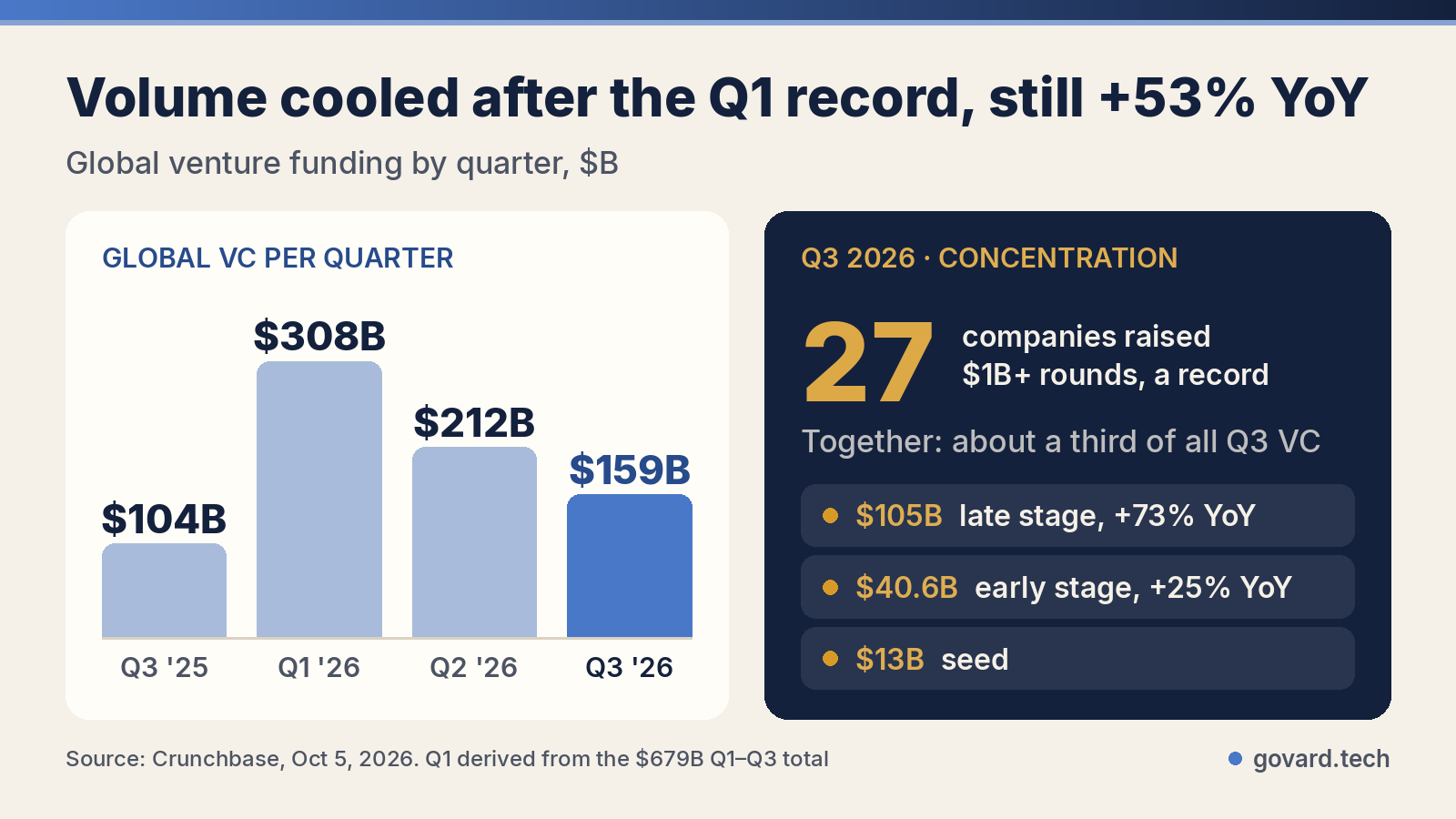
Quarterly volume follows the same curve:
- Q3 2025: $104B.
- Q1 2026: about $308B. Crunchbase reports $679B for Q1–Q3, so Q1 is derived from that total.
- Q2 2026: $212B.
- Q3 2026: $159B, down 25% from Q2 and up 53% year over year.
The more important number for founders is concentration. A record 27 companies raised rounds of $1B or more in Q3. Together they took about a third of all venture capital in the quarter.
The growth also sits in late stages. Late-stage funding reached $105B, up 73% year over year. Early stage reached $40.6B, up 25%. Seed came in at $13B.
03 · AI leaders re-price in months
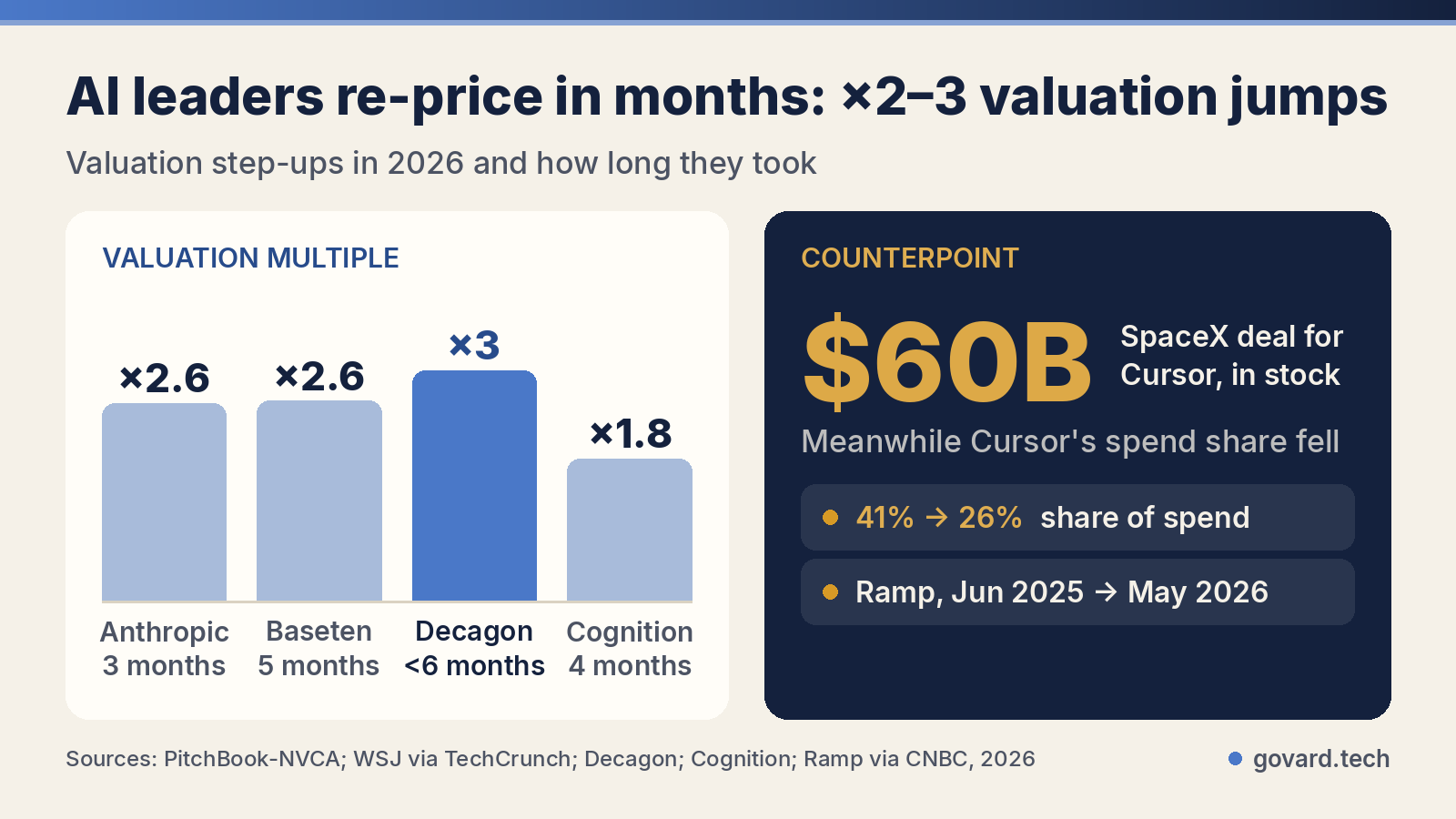
Concentration shows up in prices too:
- Anthropic. Pre-money valuation went from $350B to $900B in three months, a 157% step-up (PitchBook-NVCA). Post-money after the $65B Series H is $965B.
- Baseten, inference infrastructure. Per WSJ, it was raising $1.5B at $13B, five months after a round at $5B. Some investors came in at $11B, so the headline price overstates the average entry.
- Decagon, support agents. It tripled its valuation to $4.5B in under six months.
- Cognition, coding agents. It went from $26B in May to $48B in September 2026 with a $2B+ Series E.
Revenue explains part of it. Sierra, another support-agent company, reported $150M ARR in February 2026, up from $100M at the end of November 2025, and raised $950M at a valuation above $15B.
Price and market position can diverge. SpaceX is buying Cursor for $60B in stock. At the same time, Ramp spending data shows Cursor’s share of coding-tool spend falling from 41% in June 2025 to about 26% in May 2026. A large exit and a shrinking market share can happen at once.
04 · Classic SaaS got repriced
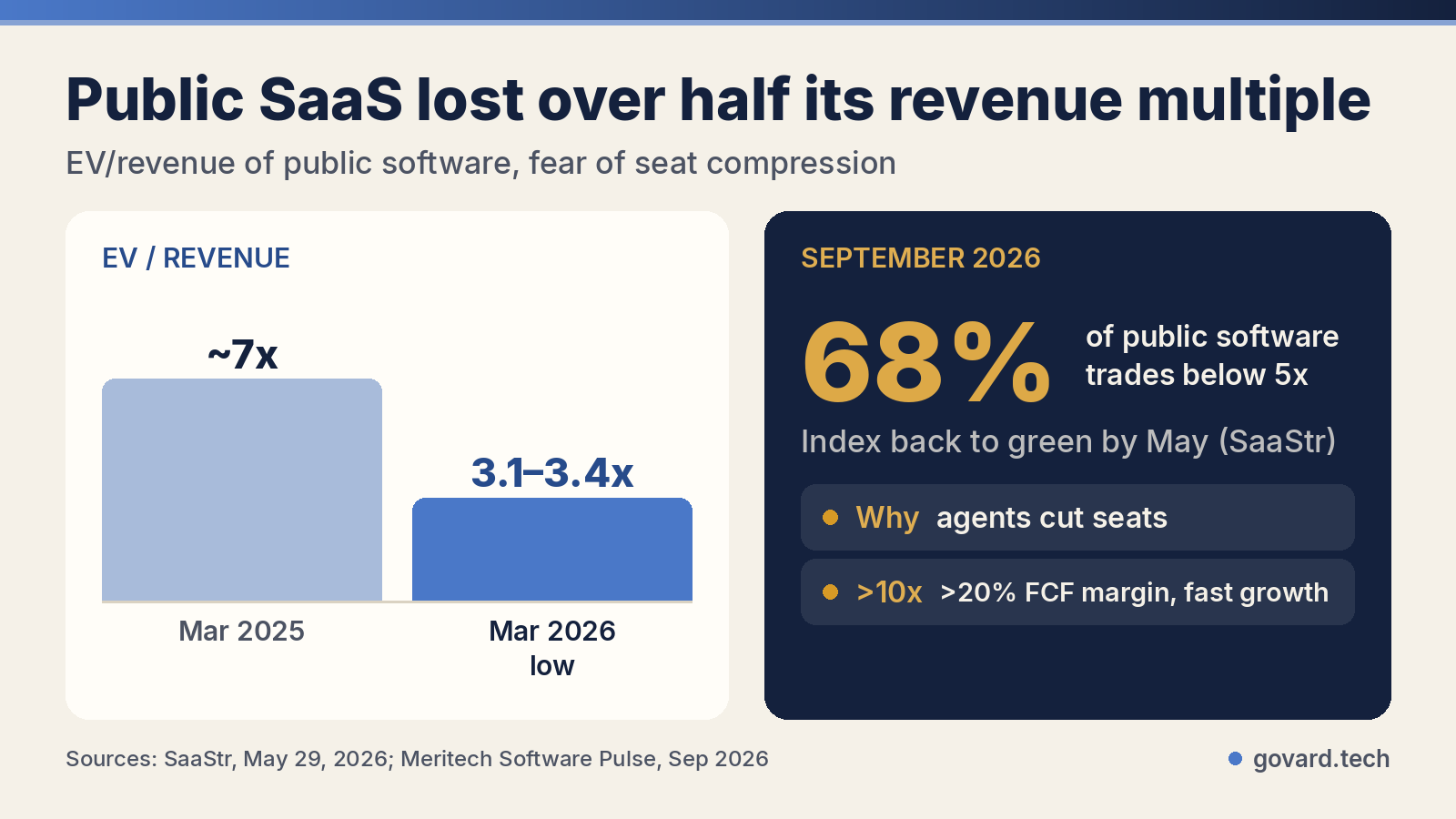
Public markets ran the opposite move. According to SaaStr, public software EV/revenue fell from about 7x a year earlier to 3.1–3.4x at the March 2026 low. The narrative behind the selloff was seat compression: AI agents replace human seats, and seat-based pricing collapses with them.
By late May SaaStr called the selloff over at the index level. The repricing stayed: in September 68% of public software companies still traded below 5x revenue, according to Meritech. Most companies above 10x combine high profitability, over 20% free-cash-flow margin, with fast growth.
05 · Sales, marketing and CRM: the clearest example
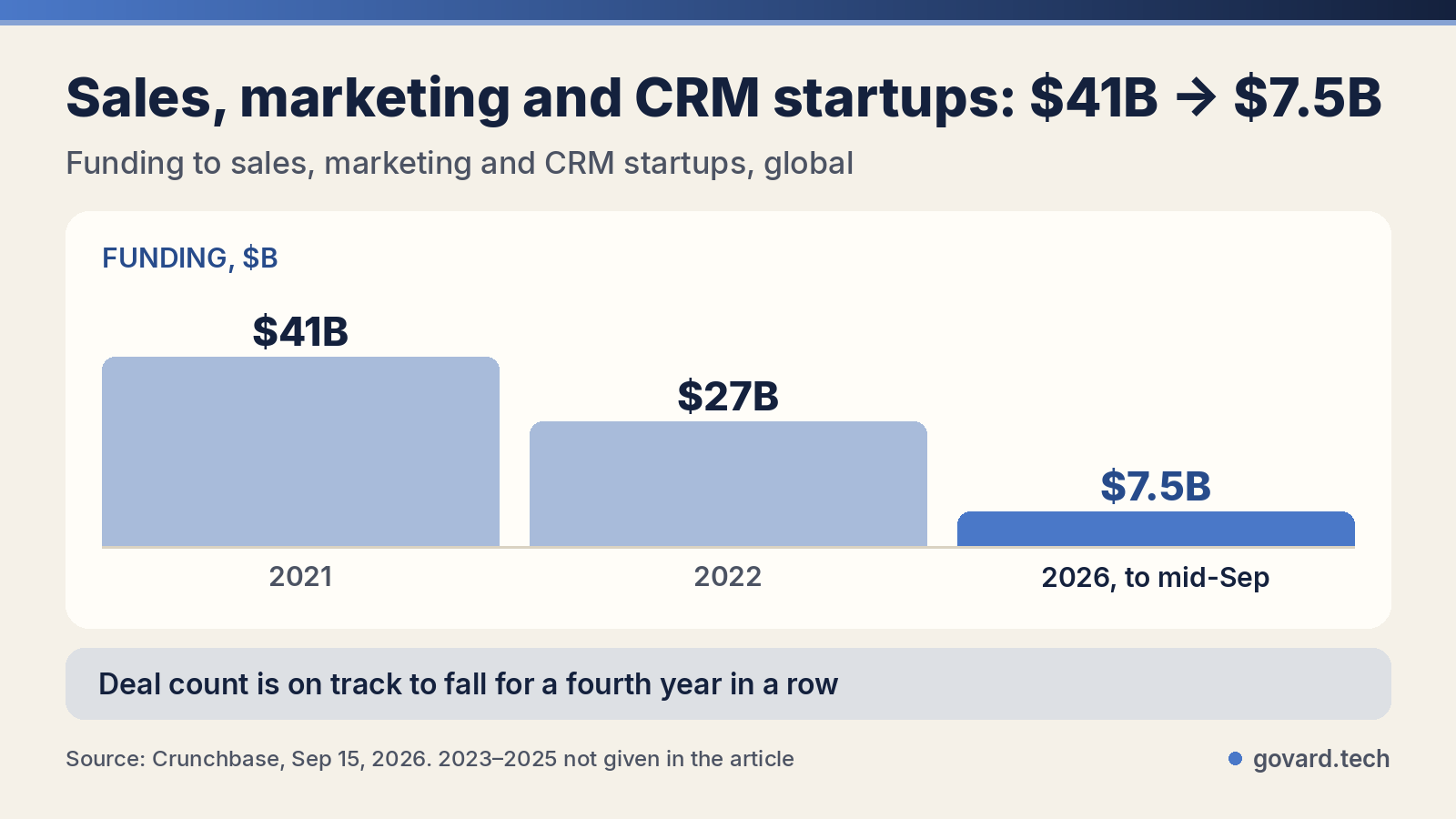
The category closest to classic per-seat software shows the shift most clearly. Startups in sales, marketing and CRM raised $7.5B globally through mid-September 2026, across 830 rounds. In 2022 the sector raised $27B, and in 2021, at the peak, nearly $41B.
Deal count is on track to fall for a fourth consecutive year. Crunchbase describes it as investors “putting more money into fewer companies”. Most of the money that does reach the sector goes to companies in AI-related categories.
06 · Where this picture breaks
Each of these numbers has a limit:
- Trackers count differently. Crunchbase reports $510B for H1 2026 worldwide. PitchBook-NVCA reports $412.7B for the US alone. KPMG reports about $560B worldwide. Compare numbers within one tracker only.
- Revenue figures are company claims. Sierra’s ARR comes from Sierra itself.
- Some valuations are hard to compare. Baseten’s round is split-priced, and the Cursor deal is paid in stock.
- Spending data has a narrow base. Ramp tracks spending by customers of one fintech platform, which is a slice of the market.
- The Q3 picture is one source. PitchBook, CB Insights and KPMG haven’t published Q3 2026 yet.
The direction is consistent across sources: more money into AI, fewer companies sharing most of it.
07 · Raising in 2026: four moves for founders
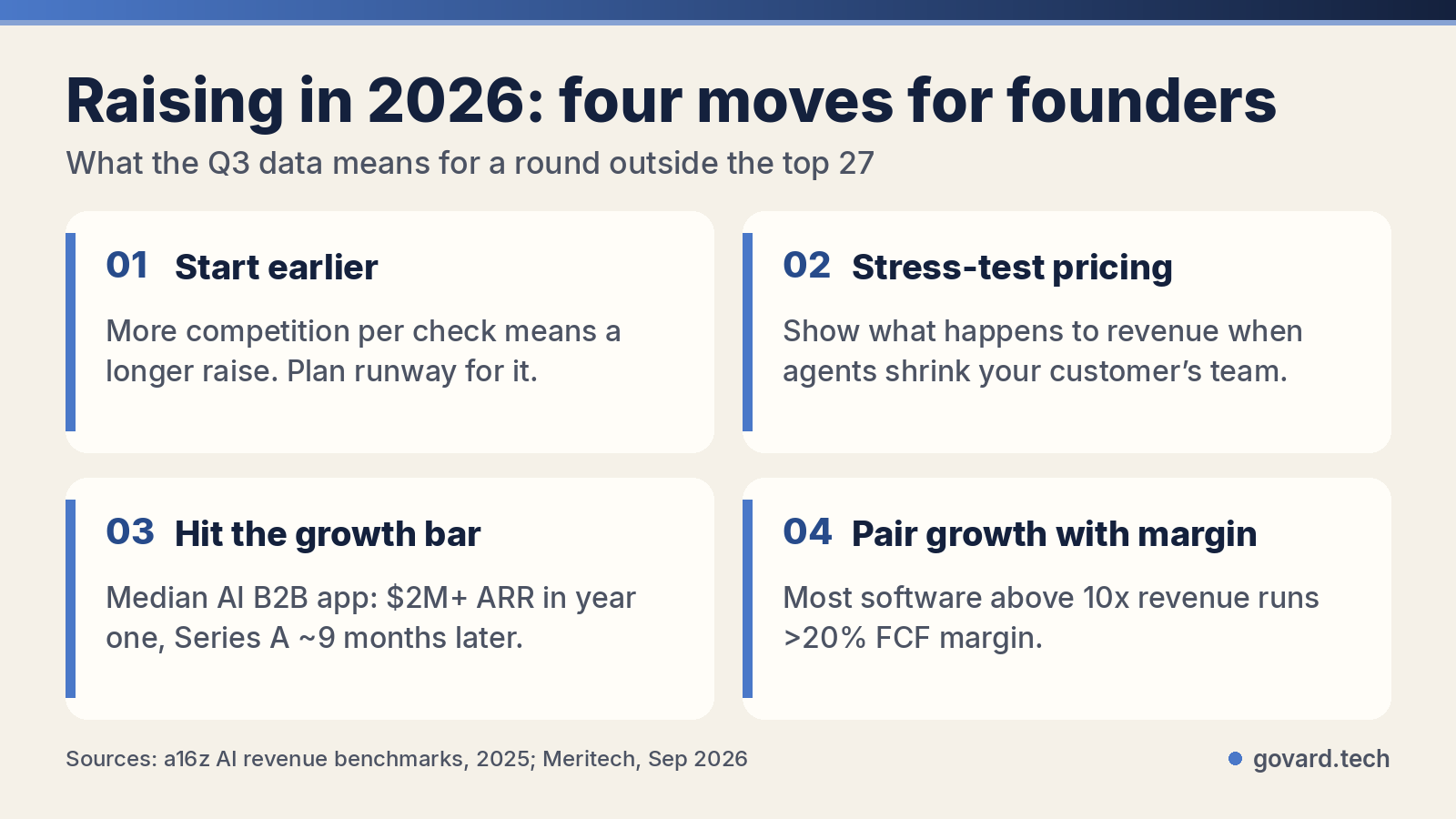
This section is my read of the data.
- Start earlier. 27 companies took a third of Q3 money. Everyone else competes harder for each check, so plan runway for a longer raise.
- Stress-test your pricing. If you charge per seat, show what happens to revenue when agents shrink your customer’s team. After the March selloff, expect this question in diligence.
- Know the growth bar. In a16z’s 2025 data, the median AI B2B app passed $2M ARR in its first year and raised a Series A about nine months after it started charging.
- Pair growth with margin. Public markets show what gets rewarded: most software companies above 10x revenue are highly profitable and growing quickly.
Before the first investor call, run a quick check:
- What share of your revenue depends on your customer’s headcount?
- Where is your first-year ARR against the $2M median for AI B2B apps (a16z, 2025)?
- Where is your free-cash-flow margin against 20%, the bar most software above 10x revenue clears (Meritech)?
If two answers are weak, fix pricing or margin before you raise.
If you’re raising now: what share of your revenue depends on how many people your customer employs?
Sources
- Crunchbase News, Q3 2026 global funding (Oct 5, 2026): https://news.crunchbase.com/venture/q3-2026-global-startup-funding-ai-billion-dollar-rounds-exits-data/
- Crunchbase News, capital concentrated in AI in Q1 2026 (Apr 16, 2026): https://news.crunchbase.com/venture/capital-concentrated-ai-global-q1-2026/
- Crunchbase News, H1 2026 record (Jul 2, 2026): https://news.crunchbase.com/venture/global-startup-exits-ipo-ma-soar-ai-q2-h1-2026/
- Crunchbase News, sales, marketing and CRM startup funding (Sep 15, 2026): https://news.crunchbase.com/sales-marketing/ai-growing-share-ecommerce-saas-crm-startup-funding/
- PitchBook-NVCA Venture Monitor Q2 2026 (Jul 2026): https://nvca.org/wp-content/uploads/2026/07/Q2-2026-PitchBook-NVCA-Venture-Monitor.pdf
- Anthropic, Series H (May 28, 2026): https://www.anthropic.com/news/series-h
- TechCrunch on Baseten, citing WSJ (Jun 18, 2026): https://techcrunch.com/2026/06/18/ai-inference-startup-baseten-reportedly-raising-1-5b-months-after-its-last-mega-round/
- Decagon, Series D (Jan 27, 2026): https://decagon.ai/blog/series-d-announcement
- Cognition blog, Series E (Sep 8, 2026): https://cognition.ai/blog
- TechCrunch on Sierra (May 4, 2026): https://techcrunch.com/2026/05/04/sierra-raises-950m-as-the-race-to-own-enterprise-ai-gets-serious/
- CNBC on SpaceX and Cursor (Jun 16, 2026): https://www.cnbc.com/2026/06/16/spacex-spcx-cursor-acquisition-ipo.html
- SaaStr, public software back to green (May 29, 2026): https://www.saastr.com/the-saaspocalypse-is-officially-over-public-software-is-back-to-green-at-the-index-level/
- Meritech Software Pulse (Sep 2026): https://meritech.substack.com/p/meritech-software-pulse-11-september
- a16z, AI app revenue benchmarks (Jun 6, 2025): https://a16z.com/revenue-benchmarks-ai-apps/