The same AI quality gets 47% cheaper every quarter. Why your agent bill doesn't
Epoch AI measures a 13× yearly drop in the cost of a fixed AI level; MIT FutureTech finds frontier runs getting 3–18× more expensive. Three reasons agent bills don't follow token prices, and how to price a task instead.
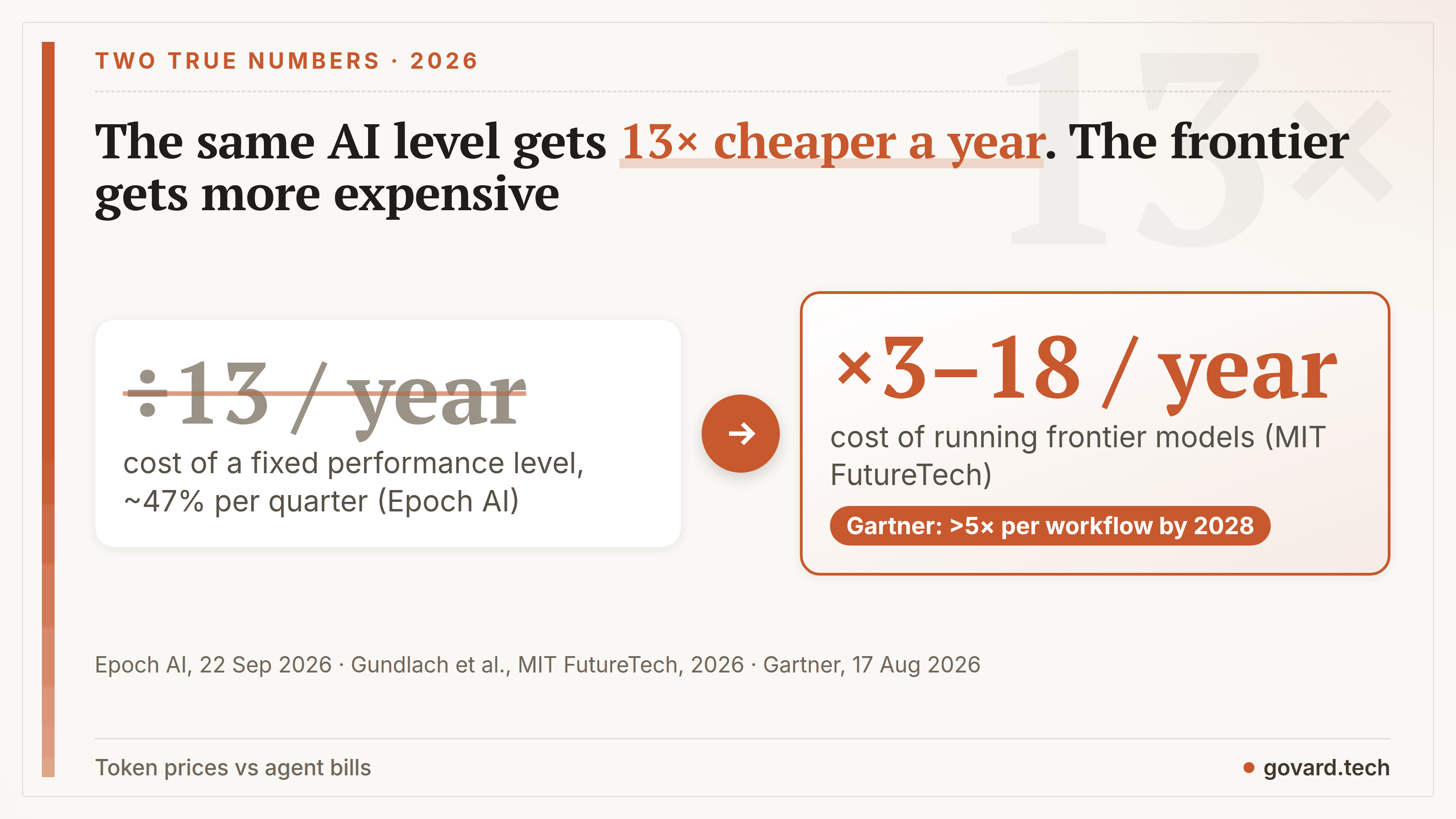
Two numbers from 2026 look like they contradict each other. Epoch AI finds that the cost of reaching a given level of AI performance has fallen about 47% per quarter since 2023, or 13× per year. Gartner forecasts that inference costs per agentic workflow will rise more than fivefold through 2028.
Both are true. They measure different things. The first is the price of yesterday’s quality. The second is the price of the work an agent does today. Below are three reasons an agent bill does not follow token prices and a way to price a task instead. Prices are from vendor price lists checked on 28 September 2026.
01 · Two true numbers
Start with the optimistic one. “The plunging price of thought” (Epoch AI, 22 September 2026) tracks what it costs to answer benchmark questions at a fixed accuracy. In January 2025 OpenAI’s o3 cost about 30 cents per question at 75% on GPQA Diamond. In 2026 GPT-5.6 Luna scored as well for $0.0004 per question.
“That is a 725-fold drop in the price of thought in under 18 months.” — Epoch AI
Epoch puts the overall rate at 13× per year: four times faster than DNA sequencing got cheaper and six times faster than compute.
Now the other side. Gundlach and colleagues at MIT FutureTech used data from Artificial Analysis and Epoch and got two curves. The price of a fixed quality level falls 5–10× per year. The cost of running frontier models rises 3–18× per year “due to bigger models and larger reasoning demands”. Gartner’s August 2026 forecast for agentic workflows points the same way.
02 · “Cheaper” depends on the ruler
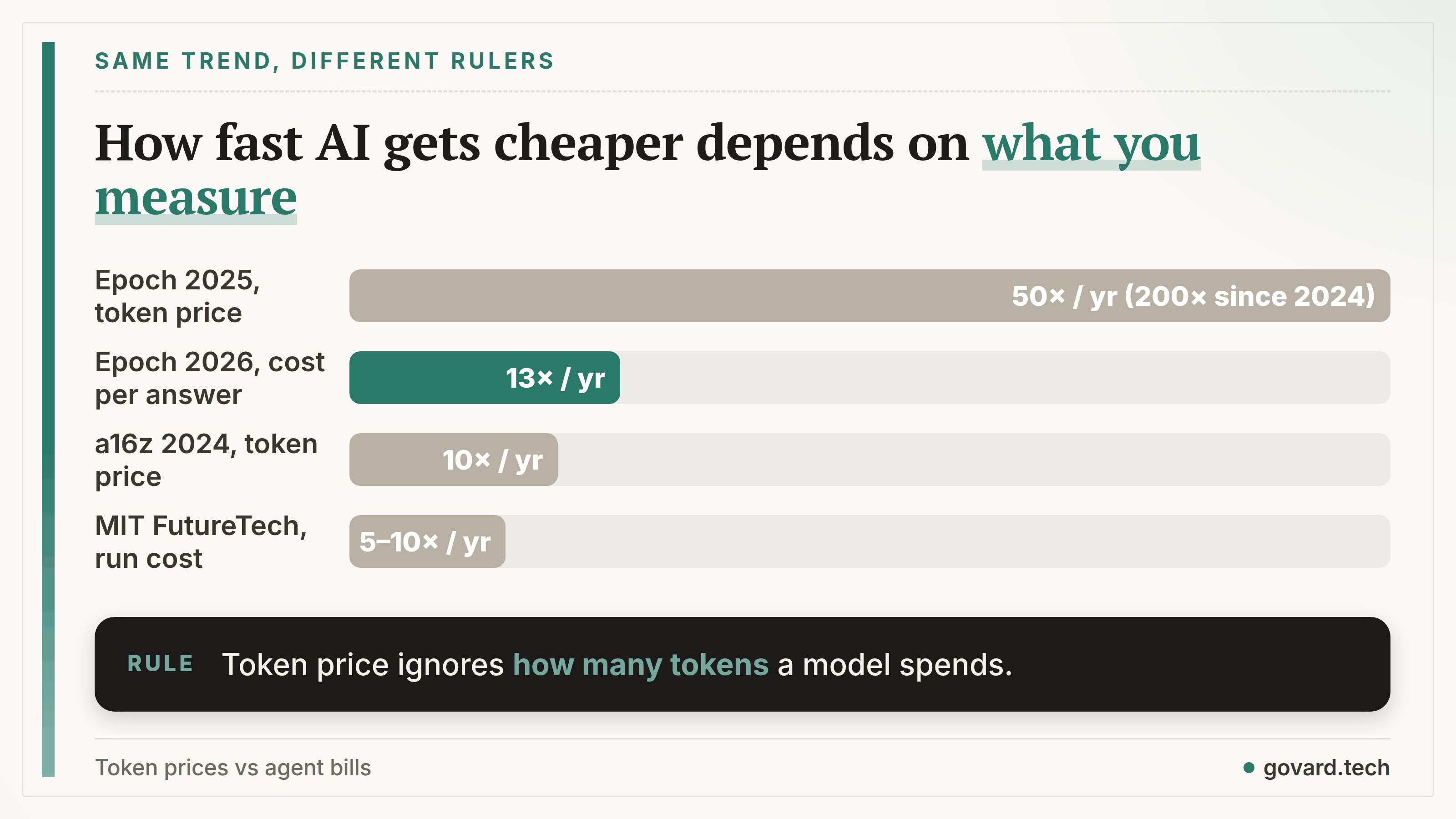
The two curves differ because they use different rulers. There are at least three, and the headline numbers come from different ones.
- Token price of the cheapest model that passes a threshold. a16z (2024) found 10× per year. GPT-3 cost $60 per million tokens in November 2021; three years later Llama 3.2 3B reached the same MMLU score for $0.06. Epoch’s 2025 study found a median of 50× per year, 200× using only data since January 2024. This ruler ignores how many tokens a model spends per answer.
- Actual cost per answered question. Epoch’s 2026 work and MIT FutureTech count the tokens models really burn, reasoning included. The rate drops to 5–13× per year.
- Cost of the best model of the day. This one goes up.
So “10×”, “13×”, “50×” and “200×” come from different measurements. A vendor deck quoting 200× and a CFO seeing a growing bill can both be right. When you read a decline figure, check whose measurement it is and what exactly was measured.
03 · Reason one: you buy today’s quality
The first reason a bill does not shrink: falling prices apply to quality you already had, and teams buy the newest quality.
Inside one model tier the price does fall. Anthropic’s Opus tier cost $15 / $75 per million input / output tokens for Opus 4.1 in 2025, $5 / $25 for Opus 4.5–5 and $4 / $20 for Opus 5.5. Above it a new tier appeared: Claude Fable 5.1 at $10 / $50. OpenAI’s top tier GPT-6 Astra also costs $10 / $50. This pattern is old. In 2024 a16z noted that o1 cost the same per output token as GPT-3 at launch, $60 per million.
Epoch’s data shows when the discount arrives. Cost falls 66% per quarter for performance that has just become state of the art; two years later it falls 32% per quarter. Epoch also names the limit of its own method: it takes the cheapest model for each level, and “real users do not switch models so often”. A team that moves to each new flagship keeps paying flagship prices every year.
04 · Reason two: agents burn tokens you don’t see
Price per token is half the bill. The other half is token count, and agents push it up in three ways.
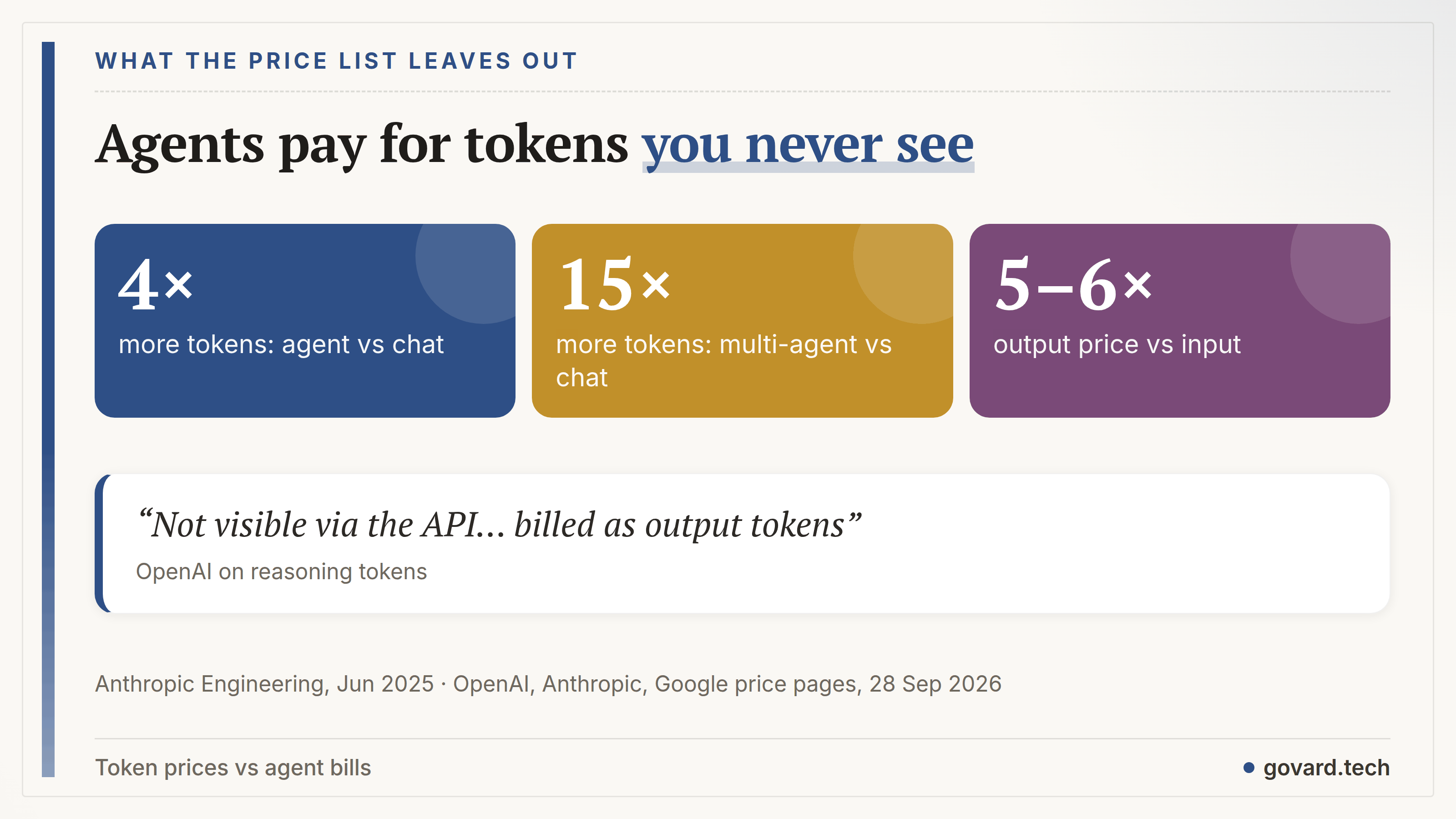
Agents use more tokens than chat. Anthropic’s engineers measured that agents use about 4× more tokens than chat, and multi-agent systems about 15×. In their research system, token usage alone explained 80% of the variance in performance on BrowseComp.
Reasoning tokens are billed as output. OpenAI: reasoning tokens “are not visible via the API” but “are billed as output tokens”. Anthropic reports thinking_tokens as the part of billed output that went to reasoning. Google states Gemini output prices “including thinking tokens”. Output costs 5–6× more than input at all three vendors.
Blended prices hide it. Artificial Analysis blends prices at a 7:2:1 ratio of cache hits, input and output. An agent that reasons at length has a larger share of output, so its real price per million tokens sits above the blended figure.
Token counts can also fall, and that is where real savings come from. On FrontierMath, about 27% accuracy took roughly 43 million output tokens with o4-mini in April 2025 and about 5 million with GPT-5.2 in December 2025. The token count fell almost 9×; after the price difference between the two models, Epoch puts the cost drop at about 3× in eight months.
05 · Reason three: the price list has multipliers
The third reason is in the footnotes of the price list. The headline rate per million tokens applies only to the default mode.
- Long context. OpenAI’s GPT-6 Astra costs $10 / $50 in short context and $20 / $75 in long context. Gemini 3.1 Pro costs $2 / $12 and $4 / $18 for prompts over 200,000 tokens. Anthropic is mostly the exception: from Claude 4.6 a 900,000-token request is billed at the same rate as a 9,000-token one, except Claude Haiku 5.5, where input above 100,000 tokens costs 5× more.
- Speed. Fast mode for Claude Opus 5.5 costs $8 / $40 against $4 / $20 in standard mode, twice the price.
- Promotions with an end date. Gemini 3.8 Flash costs $0.75 / $3.75 through 31 December 2026 and $1.50 / $7.50 from 1 January 2027. A budget built on the promo price doubles in January.
- Discounts. DeepSeek charges half price off-peak. Anthropic’s Batch API takes 50% off both input and output; a cache read typically costs 0.1× the base input price (0.025× on Fable 5.1).
06 · Price the completed task
All three reasons lead to one formula. The unit that matters is the cost of a completed task:
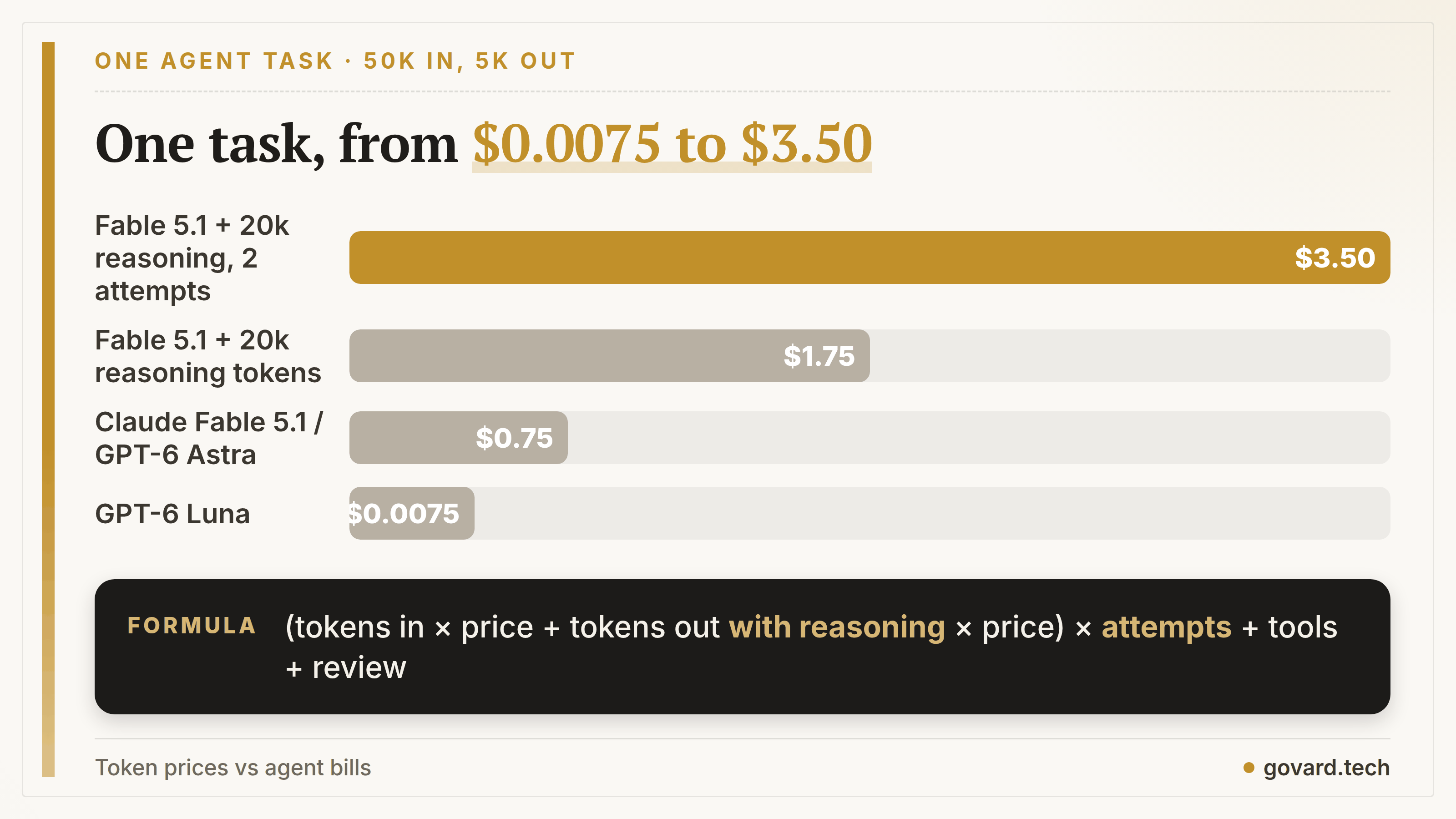
cost per task = (input tokens × input price + output tokens with reasoning × output price) × attempts per success + tools + human review
Attempts deserve their own line. The Thinkingbox benchmark (August 2026) covers 507 business workflows in five domains. The strongest model tested, Claude Opus 5, completes 66.5% of tasks on the first run. Only 47.5% are completed in all 20 of 20 runs. In the first version of the paper GPT-5.4 found at least one success in 20 tries 91.1% of the time. The authors’ conclusion: repeated inference “can often find one successful trajectory without making the agent dependable”. Every failed run is paid in full.
07 · A worked example
Take one attempt at a reference agent task: 50,000 input tokens and 5,000 output tokens, no cache. The figures are arithmetic on list prices; nobody measured them.
| Model | Price, $ per 1M (in / out) | One attempt, $ |
|---|---|---|
| Claude Opus 4.1 (2025 price) | 15 / 75 | 1.125 |
| Claude Fable 5.1 | 10 / 50 | 0.75 |
| GPT-6 Astra | 10 / 50 | 0.75 |
| Claude Opus 4.5–5 | 5 / 25 | 0.375 |
| Gemini 3.8 Flash, promo → 2027 | 0.75 / 3.75 → 1.50 / 7.50 | 0.056 → 0.113 |
| DeepSeek V4.1 Flash, peak | 0.30 / 1.20 | 0.021 |
| GPT-6 Luna | 0.10 / 0.50 | 0.0075 |
At OpenAI one attempt on GPT-6 Luna is 100× cheaper than on GPT-6 Astra. Luna handles fewer tasks than Astra. Many steps inside an agent (routing, extraction, formatting) still run fine below the top tier. Choosing the tier per step is where the biggest saving sits.
Now add the multipliers. Suppose the model also spends 20,000 hidden reasoning tokens (an illustrative assumption). On Fable 5.1 they cost $1.00, and the attempt goes from $0.75 to $1.75. If the task needs two attempts on average, it costs $3.50. With a 300,000-token prompt, Gemini 3.1 Pro costs $1.29 per attempt instead of $0.66 at the short-context rate.
08 · What gets cheaper and what doesn’t
The worked example shows which costs follow the token-price curve. Here is the full list.
| Gets cheaper | Doesn’t, or gets more expensive |
|---|---|
| A fixed quality level: ~13× per year (Epoch) | The frontier: run cost +3–18× per year (MIT FutureTech) |
| A tier inside one line: Opus $15/$75 → $5/$25 | New top tiers: $10/$50 at Anthropic and OpenAI |
| Tokens per result when reasoning gets efficient: 43M → 5M | Hidden reasoning tokens, billed as output |
| Batch (−50%), cache reads (0.1×), off-peak (−50%) | Long context (2× and more), fast mode (2×), expiring promos (2×) |
| Attempts, tools and human review |
Gartner draws the same conclusion from the other side. Its analyst Will Sommer: “Product leaders cannot rely on more efficient token economics to rationalize AI costs”. Gartner’s advice is inference tiering, routing and orchestration across several models instead of one general model everywhere.
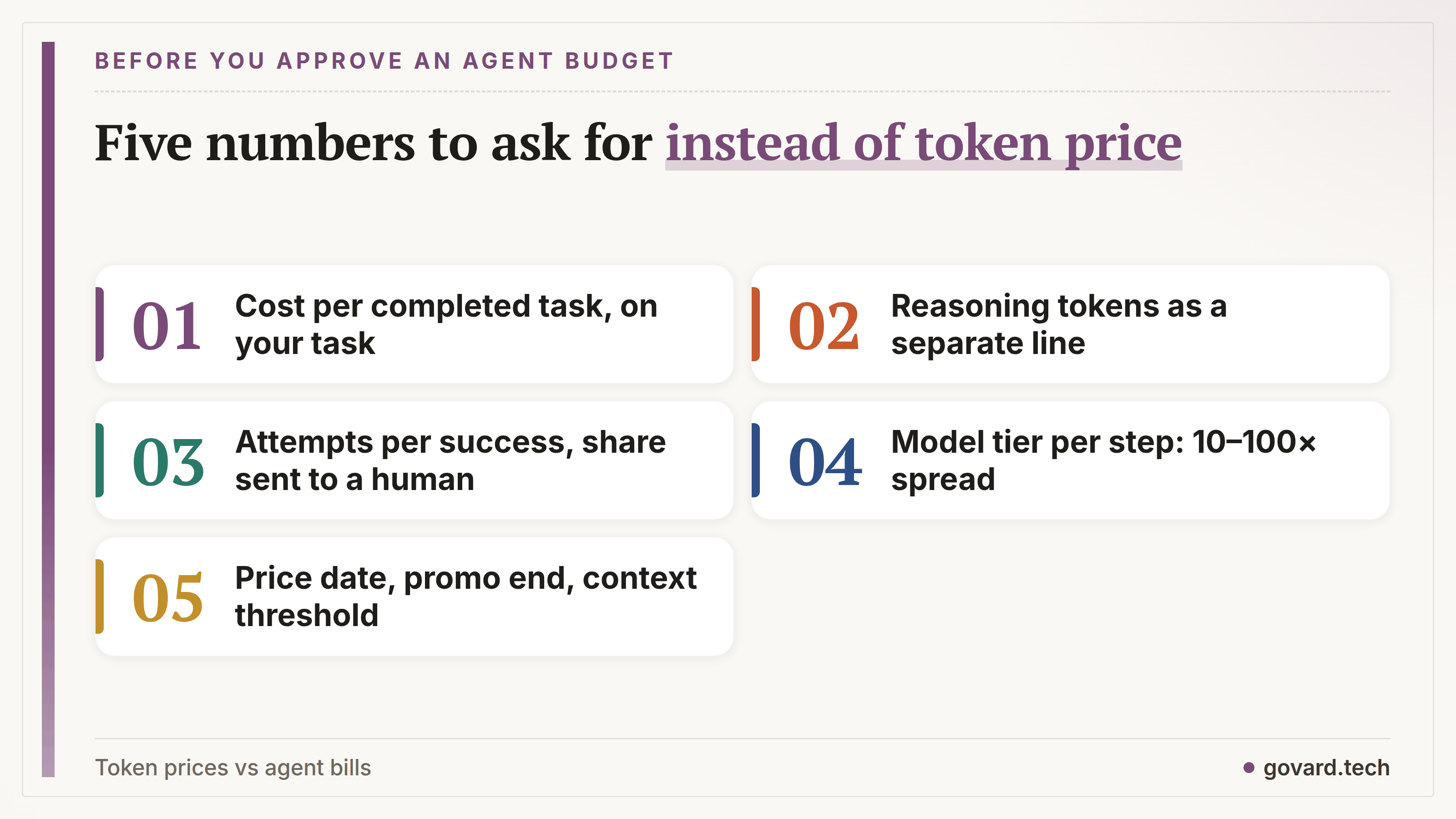
Before you approve an agent budget, check five things:
- Cost per completed task, measured on your own task with real token counts.
- Reasoning tokens logged separately. You don’t see the reasoning text, but Anthropic reports the count in
thinking_tokens. - Attempts per success and the share of tasks that reach a human.
- Tier per task: which steps really need the top model and which can go to a model 10–100× cheaper.
- Price date: when you checked the list price, and whether a promo or context threshold applies.
09 · Where these numbers stop working
The checklist rests on public data, and the data has limits.
- Benchmarks may overstate the decline. Epoch warns that models can be tuned to benchmarks and that users don’t move to the cheapest model each month. Epoch’s Jean-Stanislas Denain adds that distilled models are more brittle and do disproportionately well on benchmarks.
- Prices change monthly. Between two checks on 27 and 28 September the top tiers on the Anthropic and OpenAI price pages changed (Fable 5.1, GPT-6). Date every price you quote.
- Thinkingbox measures reliability on its own set of workflows. Your attempts-per-success figure has to come from your own logs.
- Gartner’s fivefold figure is a forecast.
What does one completed task cost in your agent, and which step takes most of it? If you have measured it, I’d like to compare notes in the comments on LinkedIn.