AI pricing models in 2026: seats, credits or outcomes, and why hybrid became the most common choice
How AI products charge in 2026: seat add-ons, usage credits and outcome-based pricing, with examples from Intercom, Zendesk, HubSpot, Salesforce, GitHub and Cursor, survey data on hybrid pricing and margins, and a checklist for choosing a model.
Buyers who care most about price want opposite things from core software and from AI. In a 2026 survey by the analyst firm Futurum, those buyers ranked per-seat pricing last for core software (12.6%) and first for AI billed separately (42.3%). Vendors meanwhile move AI away from seats, because an AI feature costs more the more customers use it, and a seat costs the same either way.
The compromise is the hybrid. Kyle Poyar, author of the Growth Unhinged newsletter, surveyed 230+ B2B companies in 2026 with billing vendor Metronome: hybrid pricing is the most common model at 37%, 29% already sell AI credits and another 33% plan to within a year. Prices below are as listed on vendor pages on 10 October 2026, except where a date is given.
01 · Why seats stop working for AI
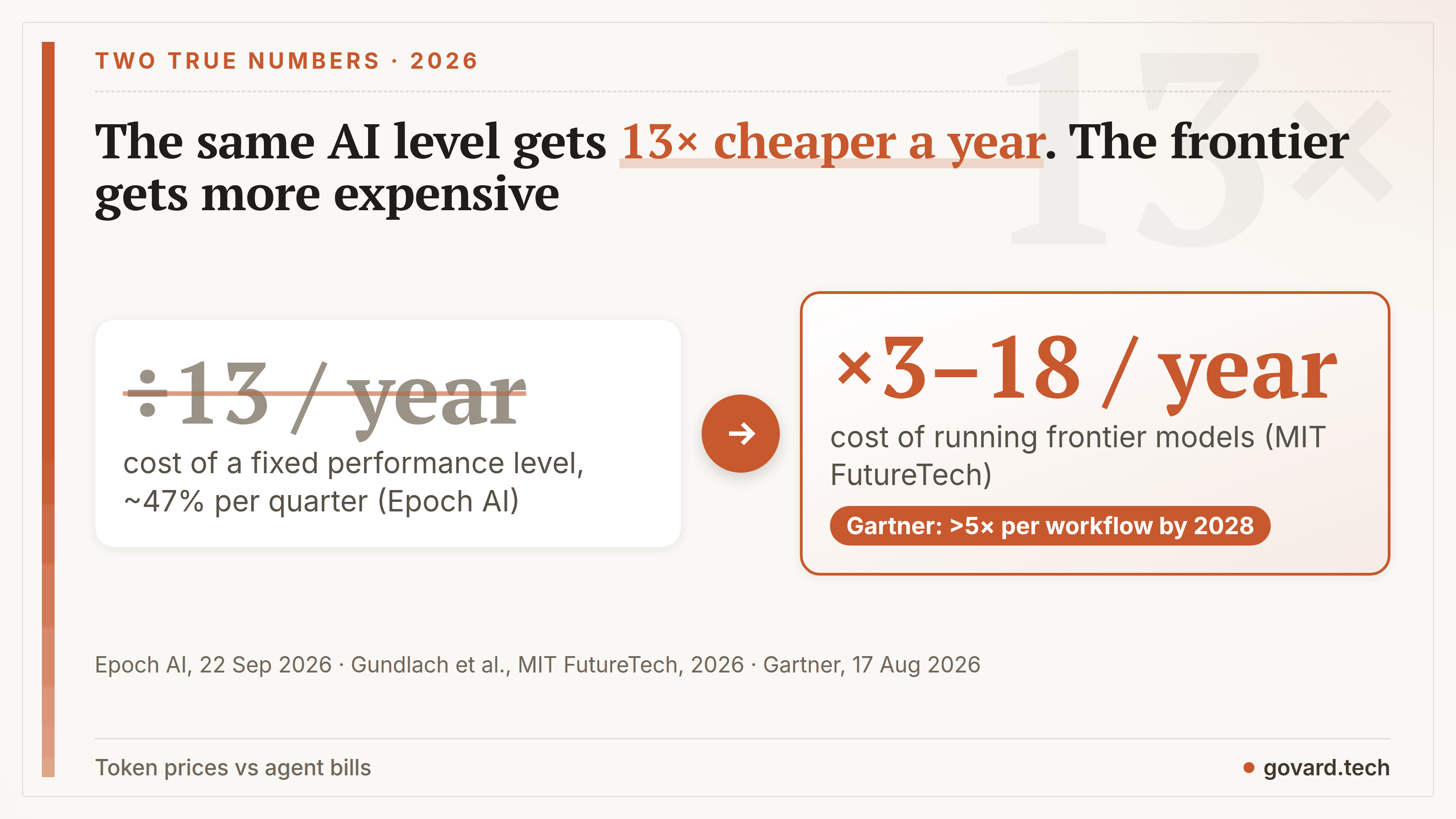
The seat model assumes the cost of serving a customer barely depends on usage. For AI features that is false: every request spends model tokens, and agents spend many of them. The token price breakdown shows why that bill doesn’t shrink on its own, and AI agents in product covers how vendors started to charge for agent work.
Margins show the pressure. In Poyar’s 2026 survey the median target gross margin for AI products is about 50%, and only 12% of companies aim for SaaS-like margins of 80% or more. ICONIQ, a growth investor that surveyed about 300 executives, projects average AI product margins of about 52% for 2026. Bessemer’s 2025 report found that the fastest-growing AI startups it calls “Supernovas” run at about 25% gross margin on average, often negative.
a16z summed up the shift back in December 2024: “Per-seat is no longer the atomic unit of software.”
02 · Three models, with real prices
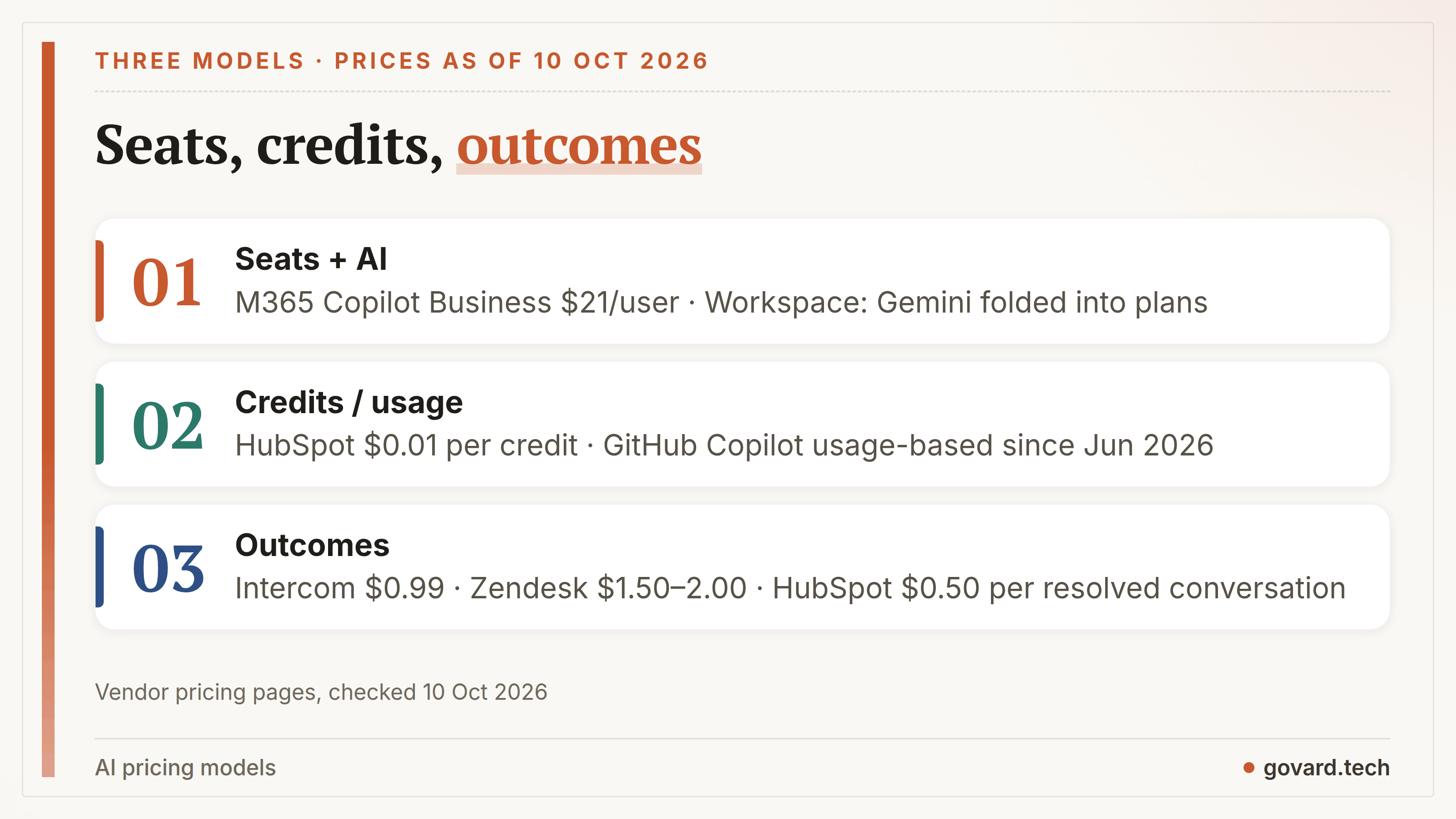
1. Seats with AI included or added on. The customer pays per user; AI is either an add-on or part of a higher plan.
- Microsoft 365 Copilot Business for companies up to 300 users: $21 per user per month, with a $18 promotion for July–December 2026. Copilot Chat is free with eligible plans.
- Google folded Gemini into Workspace plans in January 2025 and stopped selling the add-ons. Google’s own example: Business Standard plus Gemini went from $32 to $14 per user per month; the base plan price rose.
2. Credits or usage. The customer pays for consumption, usually through prepaid credits.
- HubSpot Credits cost $0.01 each; a 1,000-credit pack is $10.
- Microsoft Copilot Studio sells 25,000 credits for $200 a month; credits per action vary with usage.
- GitHub Copilot moved all plans to usage-based billing on 1 June 2026: each plan includes AI credits equal to its price, and credits are charged by tokens at model API prices. Code completions stay free.
3. Outcomes. The customer pays when the AI finishes a defined piece of work.
- Intercom Fin: $0.99 per outcome. A resolution counts when “no further help is requested after Fin’s last answer”; a qualified lead costs $9.99.
- Zendesk: $1.50 per automated resolution on a commitment, $2.00 pay-as-you-go, on top of agent seats at $55–115 a month billed annually.
- HubSpot moved its Customer Agent from $1.00 per conversation to $0.50 per resolved conversation in April 2026.
- Salesforce launched pay-per-resolution for its Help Agent in July 2026 and doesn’t publish the price per resolution.
03 · Hybrid is the most common choice
Look closely at the outcome examples and almost all of them are hybrids. Zendesk charges seats plus resolutions. Intercom sells its own helpdesk seats and charges per outcome; on third-party helpdesks Fin has a 50-outcome monthly minimum. Claude for Enterprise is $20 per seat plus usage at API rates.
The surveys agree:
- Poyar 2026: 37% hybrid pricing, up from 25% a year earlier in the same survey; a separate 29% of companies let customers choose between several pricing models.
- ICONIQ 2026: 58% of AI companies keep a subscription or platform fee, 35% use consumption pricing, 18% include an outcome-based component.
- Poyar 2025: only 5% of companies used outcome-based pricing as their primary model, and 25% expected to by 2028. Outcomes are common as a component and rare as the whole price.
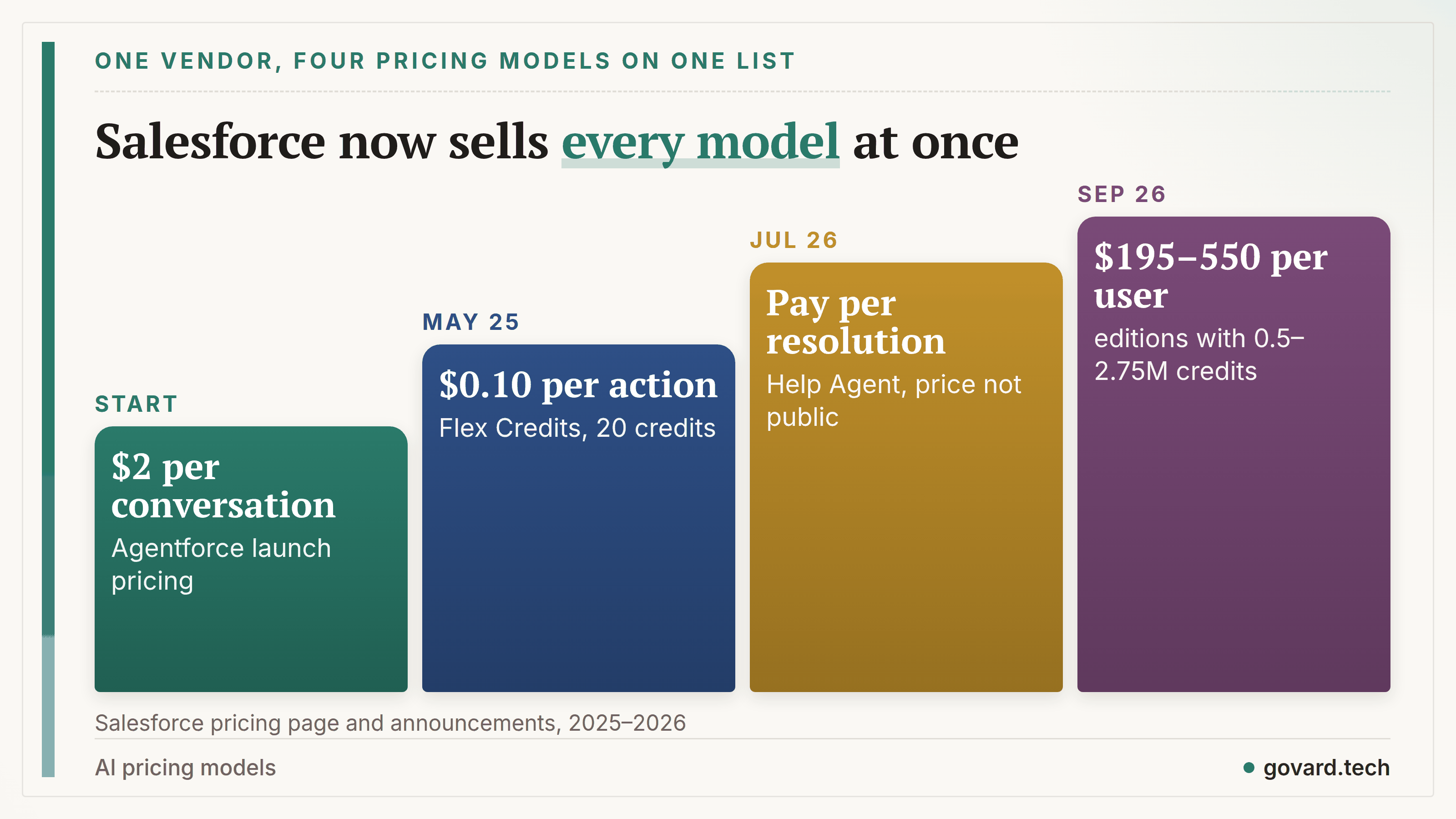
Salesforce shows how far this goes in one company. Agentforce launched at $2 per conversation; Flex Credits at $0.10 per action arrived in May 2025; pay-per-resolution for the Help Agent in July 2026; new editions in September 2026 (Core $195, Advanced $395, Max $550 per user per month) with 0.5–2.75 million Flex Credits per org per year included. By October 2026 all of these sit on the price list at once.
04 · What buyers ask for
Vendors talk about outcomes. Many buyers talk about predictability.
Futurum’s 2026 survey of enterprise software decision-makers (sample size not disclosed) found a split. Among buyers who rank price as their top criterion, seats finished last for core software (12.6%), behind consumption (28.9%) and outcomes (22.2%). For AI billed separately, seats finished first at 42.3%, ahead of consumption (36.6%) and outcomes (21.1%). Across all buyers the picture is different: the same report cites 70% preferring consumption- or outcome-linked models overall.
Ada, a customer service AI company, lived through this. It started with pay-per-resolution, and large customers then asked for prepaid annual conversation volumes. CEO Mike Murchison: “There were a lot of challenges with outcome-based pricing.” Bessemer’s summary of the case: “They wanted predictability.”
Bessemer’s pricing playbook gives the rule of thumb: “Hybrid models (base subscription + usage/outcome tiers) win when you’re uncertain.” It also names the main risk of outcome pricing for the vendor: “a difficult customer issue could consume far more compute than anticipated.”
05 · What coding tools learned the hard way
Coding assistants changed pricing fastest, and their users reacted loudest.
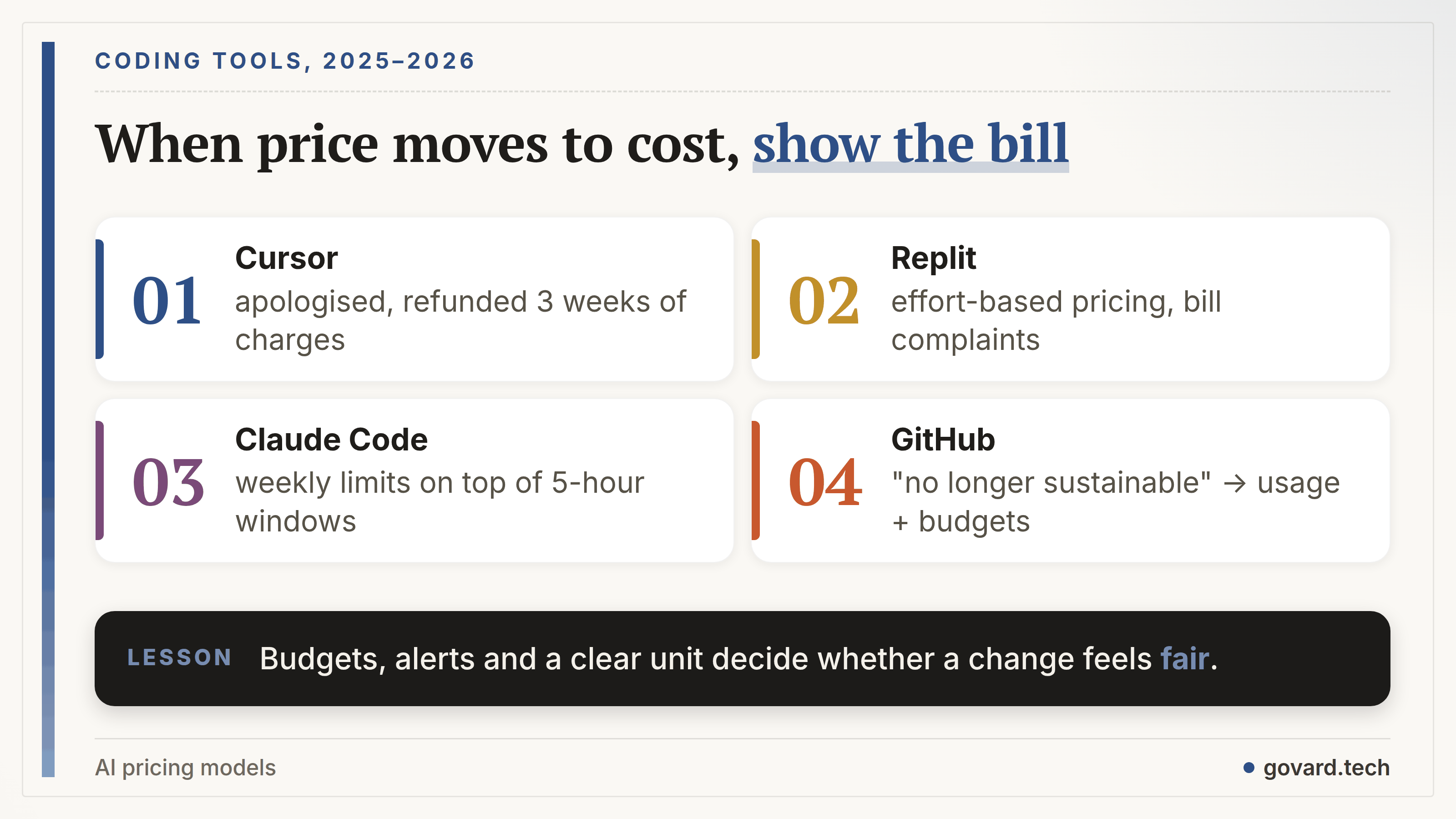
- Cursor moved Pro from request limits to $20 of included usage in June 2025. Three weeks later it wrote: “We recognize that we didn’t handle this pricing rollout well, and we’re sorry,” and refunded unexpected charges.
- Replit replaced a flat $0.25 per checkpoint with effort-based pricing. After Agent 3 launched, users complained about bills; one wrote, “I spent $1k this week alone.”
- Anthropic added weekly limits to Claude Code in August 2025 on top of five-hour windows, saying fewer than 5% of subscribers would be affected.
- GitHub explained its move to usage-based billing plainly: “the current premium request model is no longer sustainable.” With it came budgets at enterprise, cost-center and user level.
The lesson for an AI product team: when the price moves closer to cost, the customer needs a way to see and cap the bill. Budgets, alerts and a clear unit of charge decide whether a pricing change reads as fair or as a surprise.
06 · How AI credits work inside a product
Credits look simple on a price page. Inside the product they are a small billing system, and its design decides whether customers trust it.
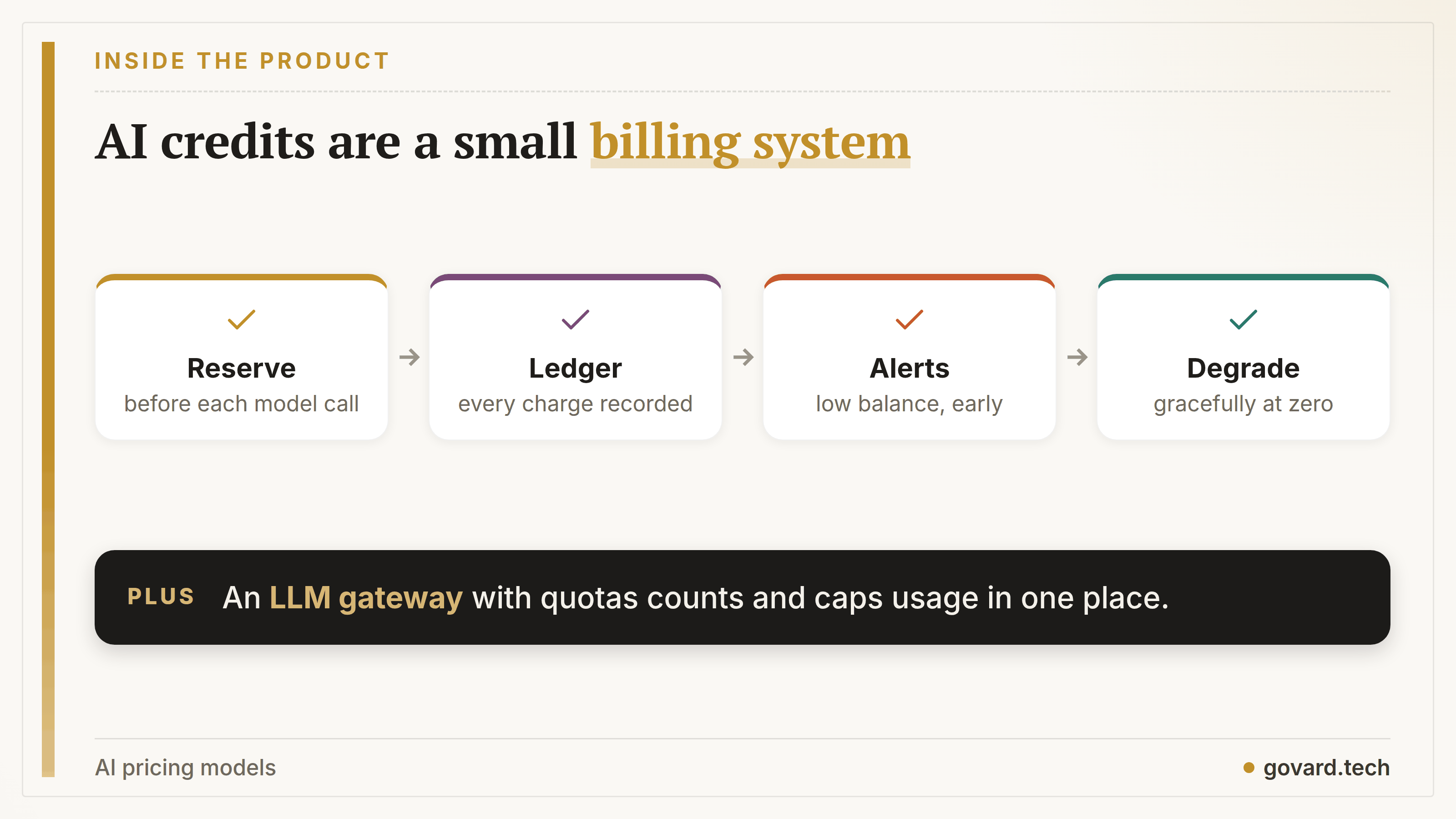
On Domovey (domovey.ru), a multi-tenant SaaS for property management companies where tenant requests from messengers become tickets and an LLM classifies them and drafts replies, we moved monetization to a free starter plan plus AI credits with top-up packs, and I built the credits system. It has four parts:
- Reserve before the call. Credits are reserved before each request to the model provider, so a company can’t overspend its balance between checks.
- A usage ledger. Every charge is recorded, so usage can be explained line by line.
- Threshold alerts. The customer hears about a low balance before the AI stops.
- Graceful degradation. When credits run out, AI intake of requests degrades gracefully.
GitHub’s budgets and spend caps address the same problem at scale. A gateway in front of the models helps too: in AgenticCRM, the agentic CRM I’m building with a team of six engineers, every model call goes through our own LLM gateway with quotas and rate limits, so usage can be counted and capped in one place.
07 · When outcome pricing works
Outcome pricing is the strongest promise and the hardest to run. It works when three conditions hold:
- The outcome is verifiable without a debate. Intercom defines a resolution in one sentence. HubSpot’s billing partner Metronome describes an automated check 72 hours after the agent’s last answer. If the customer has to agree that the job was done, every invoice becomes a negotiation.
- The vendor controls the cost of a hard case. Bessemer’s warning applies: a difficult issue can consume far more compute than anticipated, while the price per outcome stays flat.
- The outcome is the customer’s unit of value. A resolved ticket is; a generated paragraph usually isn’t.
When one condition fails, a hybrid is safer: a platform fee or seats for predictability, and an outcome or usage component for upside. That is where AgenticCRM’s pricing hypothesis sits too: a subscription, an included AI pool and pay-as-you-go above it. It is still a hypothesis to test, built on a review of HubSpot, Attio, Close, Salesforce and Freshsales pricing.
08 · Checklist: choosing a pricing model for an AI product
- Know your cost per unit of work. Measure model cost per task on real usage, including retries. Without it, any price is a guess.
- Pick the unit the customer recognises. A resolved ticket, a processed document, a qualified lead. If no such unit exists, use credits.
- Give the buyer a predictable line. A seat, a platform fee or an included pool. In Futurum’s data, price-sensitive buyers ask for exactly that for AI.
- Build the billing plumbing before launch. Reservation before the call, a ledger, alerts, caps and graceful degradation.
- Plan for change. Cursor, Replit, HubSpot, GitHub, Salesforce and Microsoft all changed AI prices in 2025–2026. Announce changes early and show customers their usage.
Which unit does your AI product charge for today, and could your customers predict next month’s bill?