AI agents in your product: how to ship, price and prove them
HubSpot bills $0.50 per resolved conversation; Attio shipped its agent in four steps. A playbook for product teams: stages, MCP, pricing, evals, oversight.
HubSpot now charges $0.50 per resolved conversation and says its Customer Agent resolves 65% of them. Attio’s 2026 changelog shows its agent growing in four steps: answer, act, automate, audit. For a product team that is the test of an agent feature: you can count the tasks it finished and bill for them.
This is a playbook for product teams that add agents to a SaaS product: how to stage the rollout, open the product to outside agents, choose a billing unit, measure reliability and decide where a human approves.
01 · The unit of value moved from seats to finished work
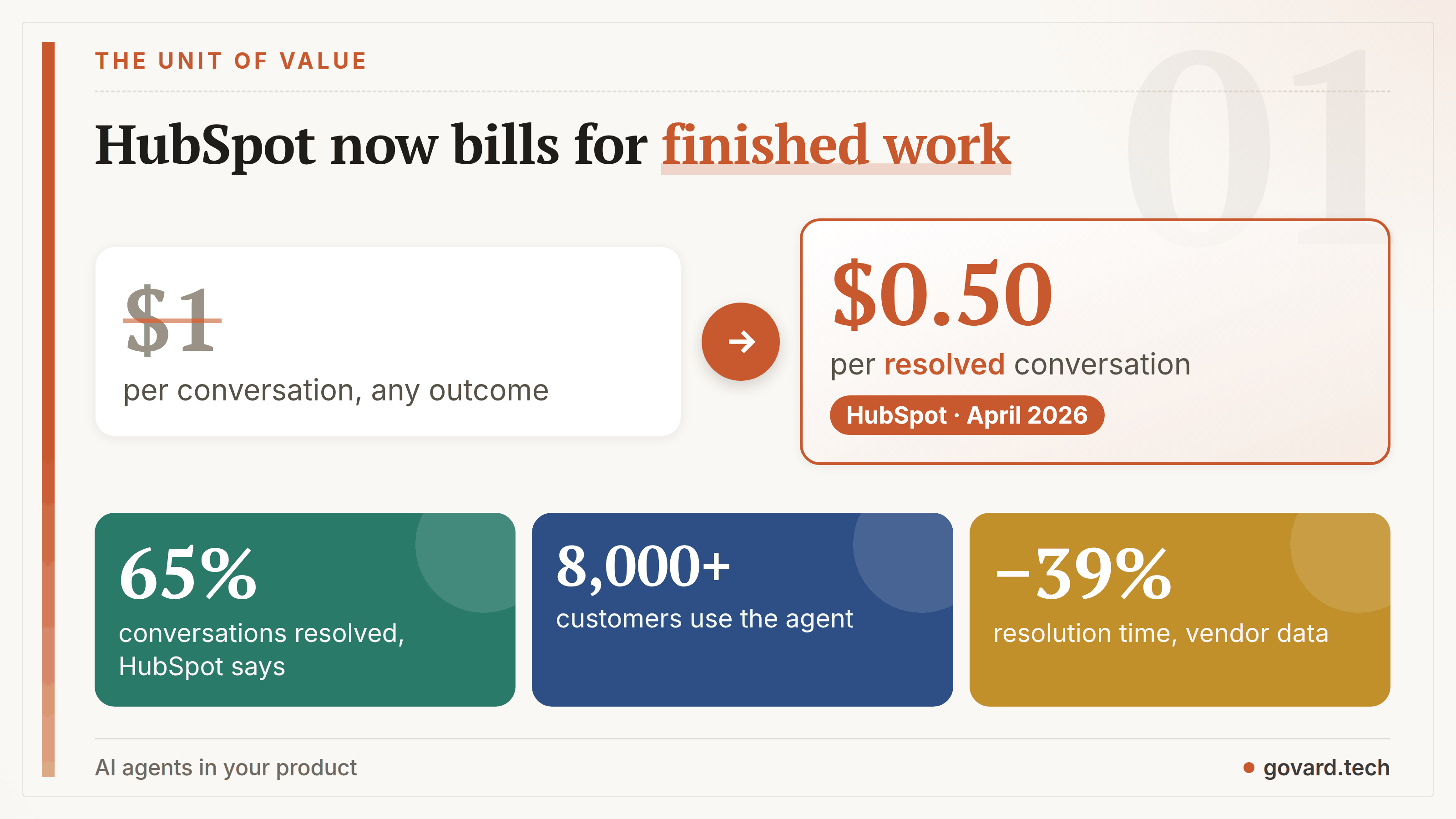
In April 2026 HubSpot changed the price of its Customer Agent. It used to be $1 for any conversation. Now it is $0.50 per resolved conversation, and the Prospecting Agent costs $1 per lead it recommends for outreach. In the same announcement HubSpot said the agent resolves 65% of conversations across more than 8,000 customers and cuts resolution time by 39%. These are the vendor’s own figures.
HubSpot is not alone:
- Intercom prices its Fin agent at $0.99 per outcome and charges once per conversation, even if Fin answers several questions.
- Zendesk describes AI agents as “paying per automated resolution”: you pay only for requests resolved without escalation to a human.
- Salesforce sells Agentforce per conversation ($2) or per action: one action costs 20 Flex Credits, which is $0.10. Agentforce ARR passed $1.5B, up over 240% year over year, in its Q2 FY27 results (August 2026).
The product question becomes: which task does the agent finish, and how do we count it? The rest of this article follows that question.
02 · Ship the agent in stages: answer, act, automate, audit
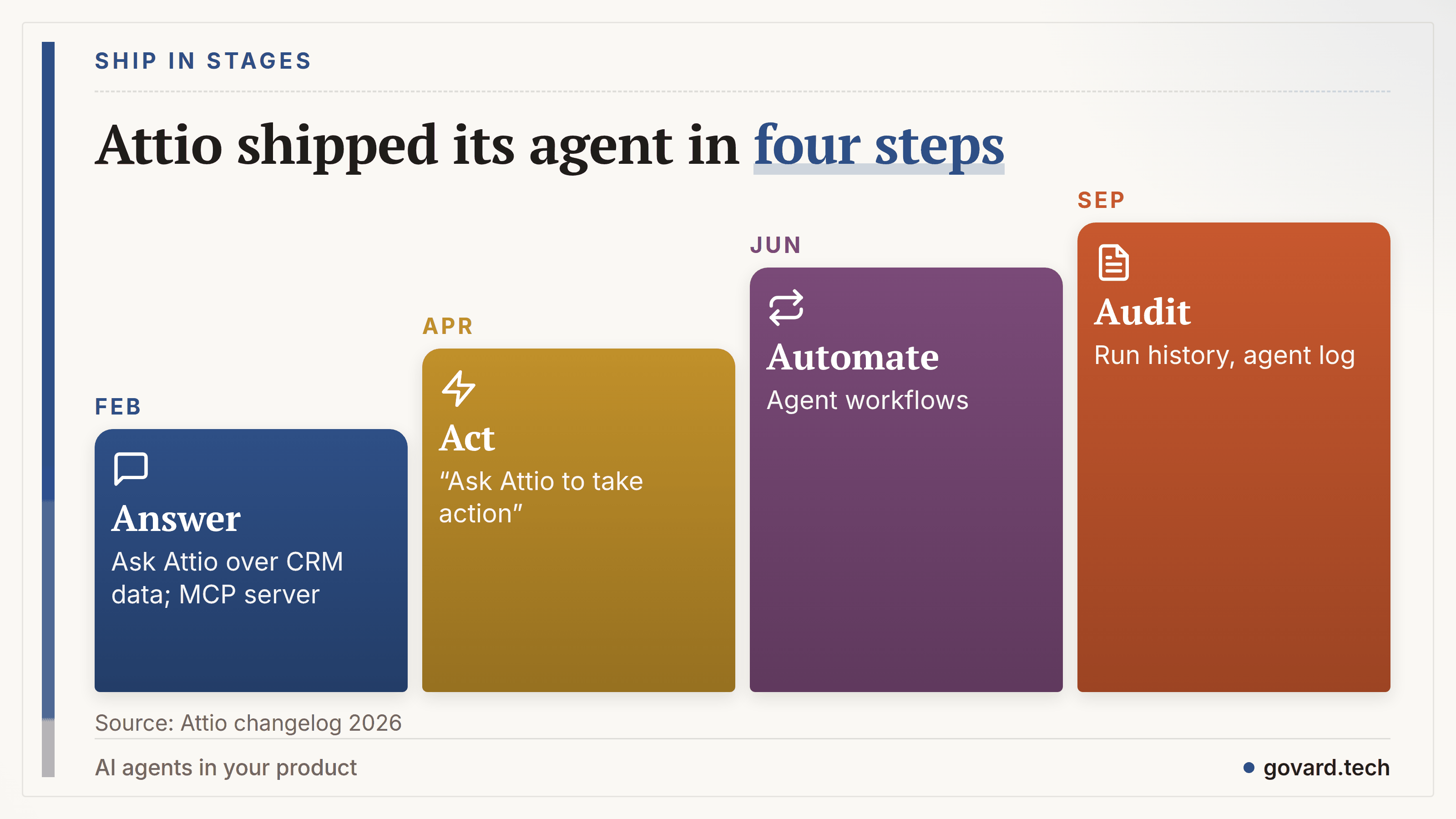
Once you know which task the agent should finish, the next decision is the order of capabilities. Attio’s 2026 changelog shows one clean sequence:
| Month | Release | Capability |
|---|---|---|
| February | Ask Attio; MCP server | Answers over CRM data; outside agents can connect |
| April | ”Ask Attio to take action” | The agent does the work |
| June | The new Workflows | Multi-step tasks on customer context |
| September | Workflow history and agent log | ”Full visibility into every run, down to the agent” |
Each release adds one capability on top of the previous one. Users first see the agent answer correctly, then let it act, then let it run chains of actions. The log arrives last in Attio’s case. My read: plan it into the first release, because it is what makes the later stages auditable.
Salesforce describes the same idea as guardrails. Its sales agent Hunter, in pilot with general availability planned for November 2026, has “guardrails that define when it can act autonomously and when seller approval is required”. Salesforce decides autonomy action by action.
03 · Open the product to outside agents through MCP
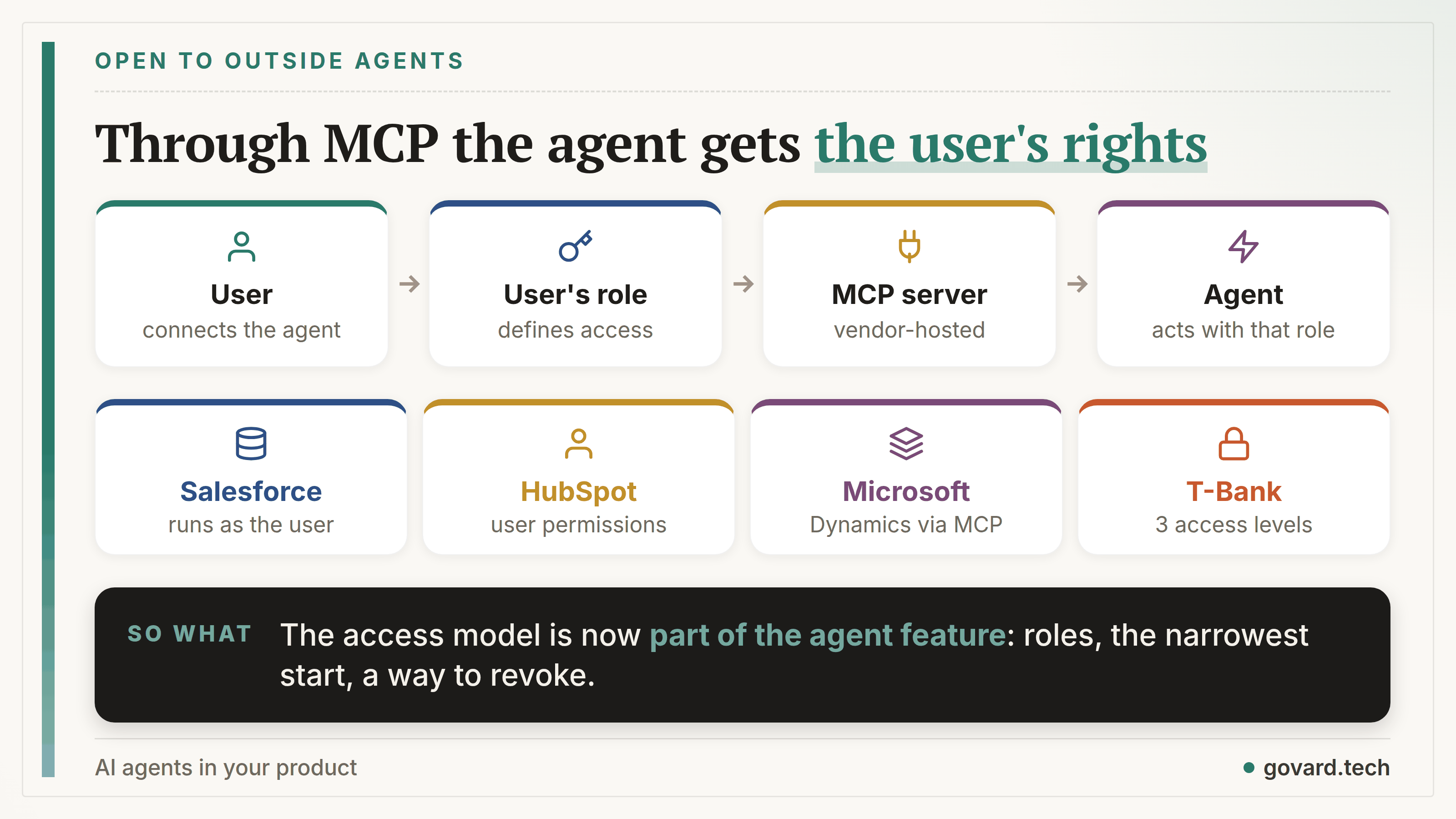
Your own agent is half of the picture. The other half is the agent your customer already uses: Claude, ChatGPT, Copilot or something built in-house. Model Context Protocol (MCP) is how that agent reaches your product, and business vendors already ship servers:
- Salesforce Hosted MCP Servers became generally available in April 2026 for Enterprise Edition and above. They expose data, flows, Apex actions and queries, and “every transaction runs as the authenticated user”.
- HubSpot’s remote MCP server gives agents read and write access to contacts, deals and activities. “All actions respect your existing HubSpot user permissions.”
- Microsoft grounds its Sales and Service agents in live Dynamics 365 CRM data “via a model context protocol (MCP) foundation”.
- T-Bank in Russia lets brokerage clients connect outside AI agents with three access levels: view only; view and place orders; orders and transfers between own accounts. The agent cannot complete an operation without the client’s confirmation.
The common design is that the agent inherits the rights of the user who connects it. For a product team, the access model is now part of the agent feature: which roles exist, what each one allows, and how a customer starts on the narrowest one.
Discovery is still messy. A developer’s count of the official MCP registry on DEV (September 2026) found 101,219 entries but only 31,309 distinct servers, and 23% of those have no source repository. My read: list your official server in the registry and link it from your docs, so customers do not pick a copy.
04 · Choose the billing unit: seat, action or outcome
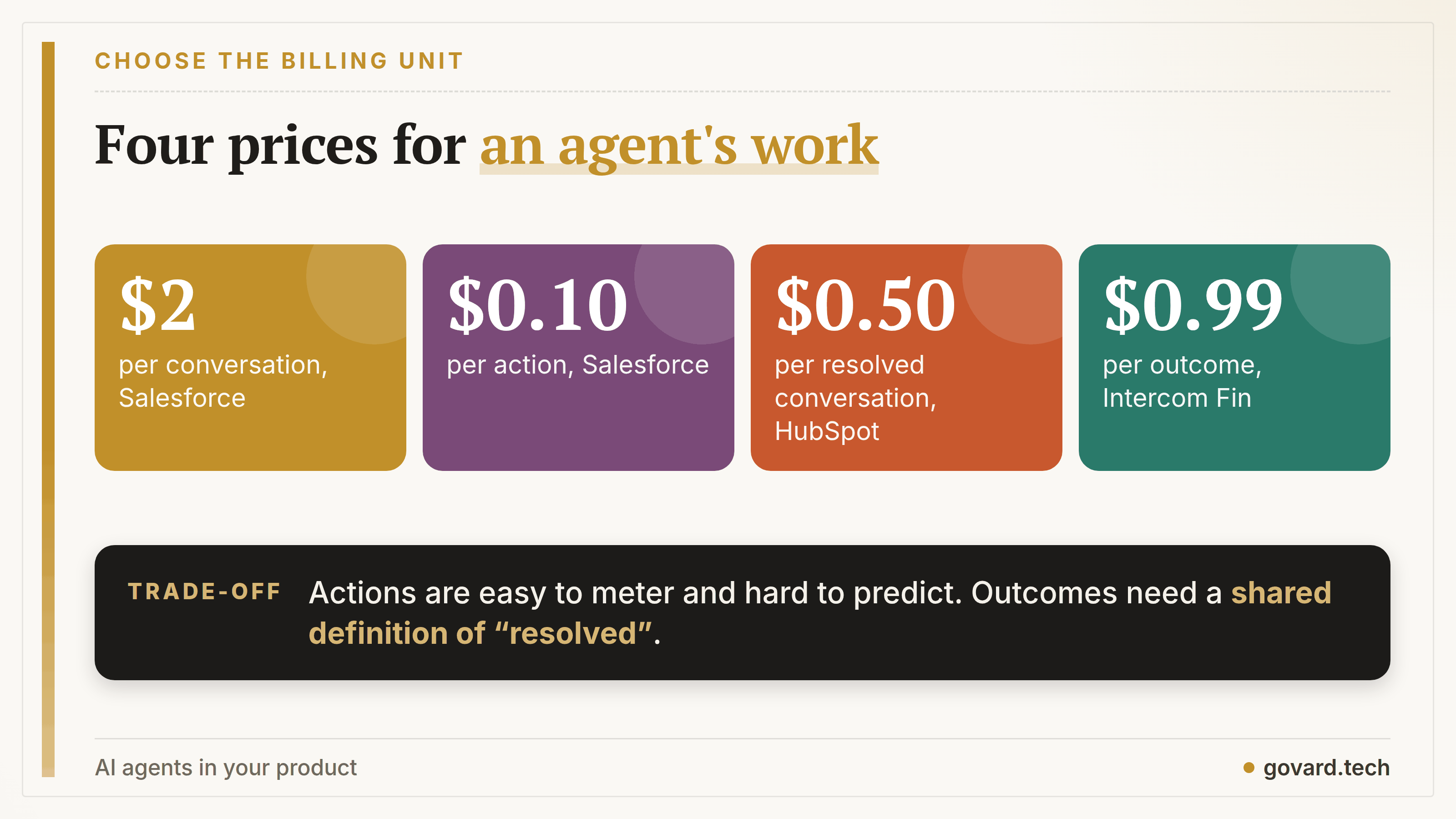
With the stages and access in place, the pricing question becomes concrete. Vendors use three units:
| Unit | Example | What the customer buys | Risk |
|---|---|---|---|
| Seat | Intercom from $29, Zendesk from $19 per seat per month | Access for people | Revenue shrinks if the agent replaces the people |
| Action | Salesforce: $0.10 per Agentforce action | Steps the agent takes | Customers struggle to predict the bill |
| Outcome | HubSpot: $0.50 per resolved conversation; Intercom: $0.99 per outcome | Finished tasks | You need a shared definition of “resolved” |
The action model is the easiest to meter and the hardest to buy. UpperEdge, an advisory firm, warns about “unexpected, massive bills from overconsuming their AI vendor’s services” and notes that customers do not understand “what an action is”. A consultant’s review of Agentforce on G2 says: “The pricing is complex and this leaves my clients very confused.”
The outcome model moves that risk to the vendor, so the definition carries the weight. Intercom counts an outcome when the customer confirms the answer, does not ask for more help, or when Fin completes a procedure, “including handoffs”. A handoff to a human can count as a billable outcome. Write your definition down before you publish a price.
05 · Measure reliability across repeated runs
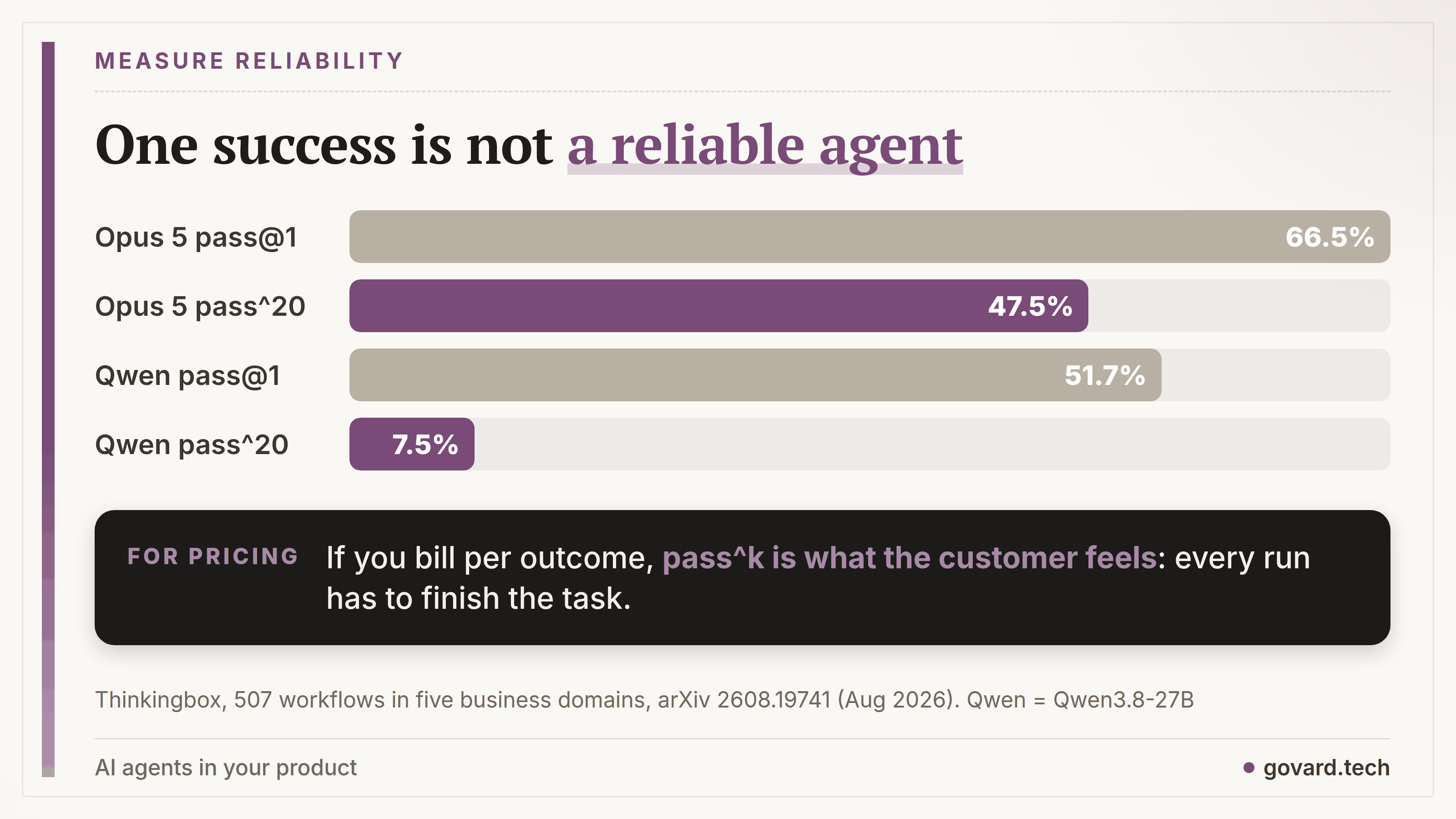
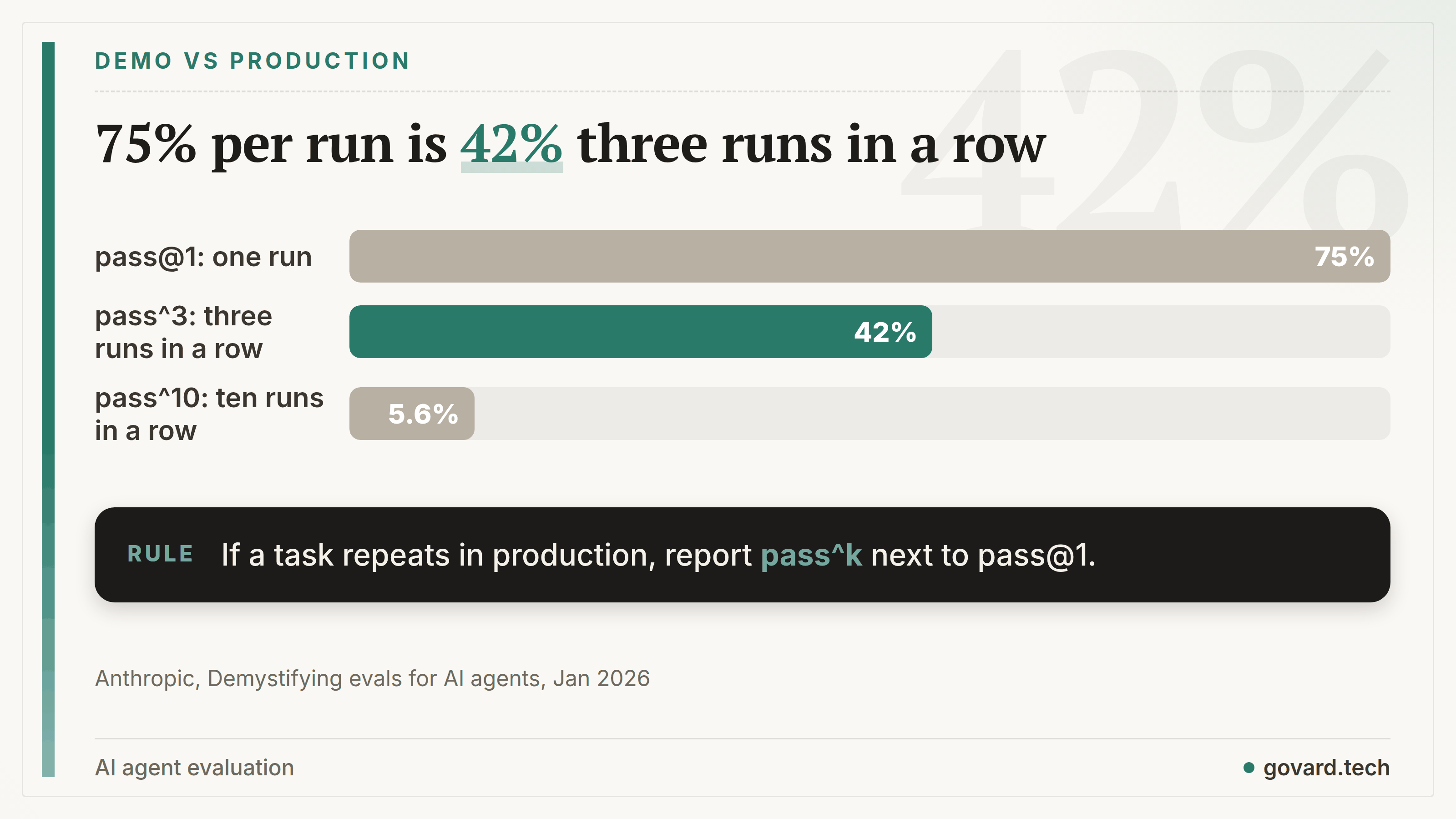
Outcome pricing assumes the agent finishes the task every time. Most demos show that it can finish it once. Two metrics separate these cases:
- pass@1: the share of tasks the agent solves in a single attempt;
- pass^k: the share of tasks where all k attempts succeed.
On Thinkingbox (v2 of the paper, August 2026), a benchmark of 507 policy-conditioned workflows in five business domains, the strongest model, Claude Opus 5, scores 66.5% pass@1 and 47.5% pass^20. Qwen3.8-27B drops from 51.7% to 7.5%. It is a synthetic benchmark: the method transfers to your product, the percentages do not. The τ-bench authors reported the same pattern in 2024: GPT-4o-class agents succeeded on fewer than 50% of tasks, and pass^8 in retail was below 25%.
For a product that charges per outcome, pass^k is closer to the customer’s experience. Anthropic’s guide to agent evals suggests starting small: “Begin with 20-50 simple tasks drawn from real failures.” Your support tickets and failed agent runs are that set.
06 · Where the case for agents is weaker than the pitch
The pricing numbers above come from vendors. Independent data is more cautious:
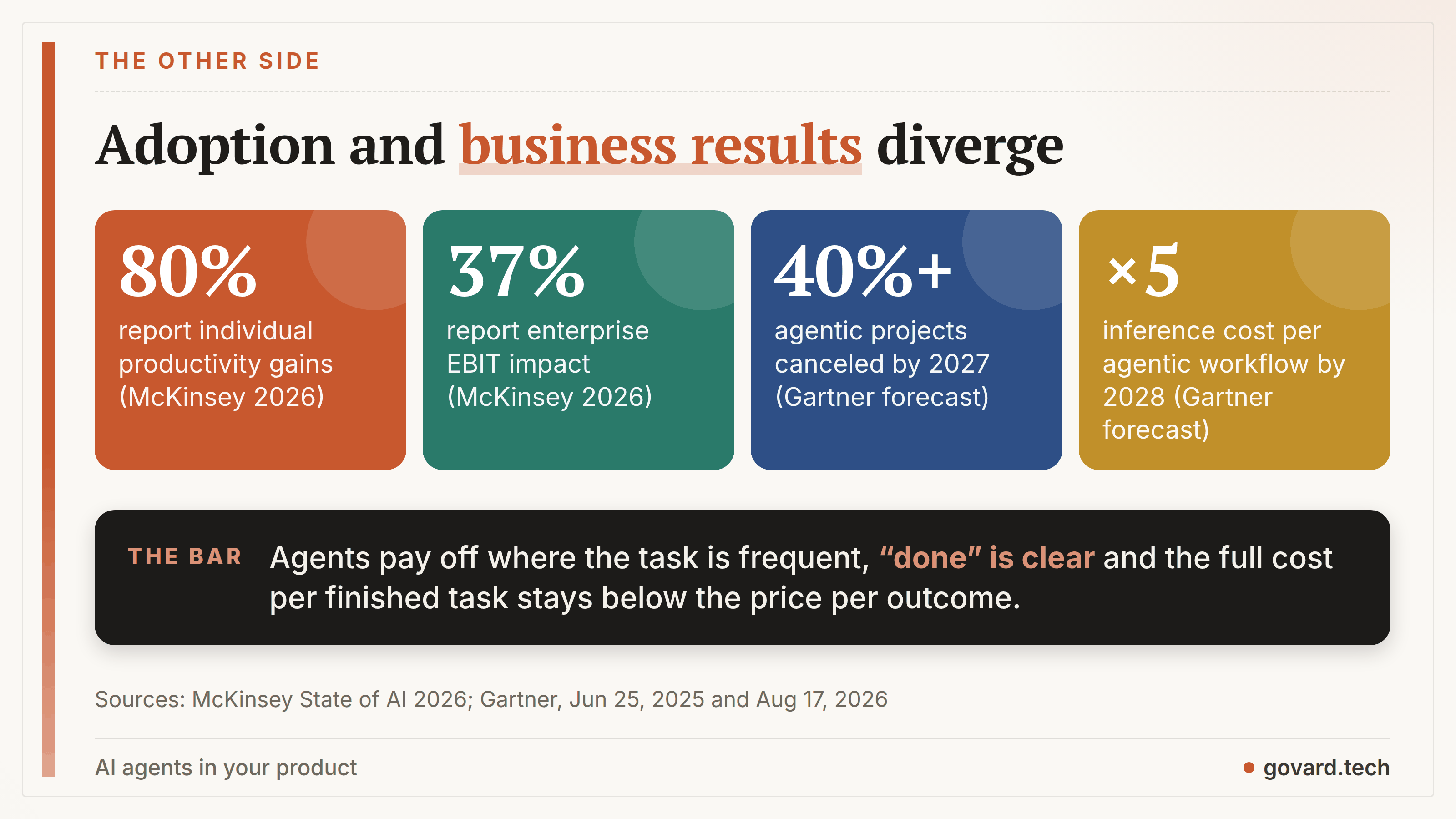
- Business impact. McKinsey’s State of AI 2026 (1,719 respondents, as summarized by explainx.ai): 80% report individual productivity gains, 37% report enterprise EBIT impact, unchanged from a year earlier.
- Project survival. In June 2025 Gartner predicted that over 40% of agentic AI projects will be canceled by the end of 2027 “due to escalating costs, unclear business value or inadequate risk controls”. It estimated that only about 130 of the thousands of agentic AI vendors are real and called much of the rest “agent washing”: assistants, RPA and chatbots rebranded without substantial agentic capabilities.
- Cost per workflow. Gartner (August 2026) expects AI inference costs per agentic workflow to “increase more than fivefold through 2028”. Anthropic measured that agents use about 4× more tokens than chats, and multi-agent systems about 15×.
- Customer service. Klarna’s assistant handled two thirds of support chats in its first month in 2024, and the company said it did the work of 700 full-time agents. By late 2025 Klarna said the agent does the work of 853 full-time agents, yet in May 2025 it turned back to human customer service representatives, according to CX Dive.
For outcome pricing this sets the bar: the agent pays off where the task is frequent, the “done” state is clear and the full cost per finished task (tokens, retries, human review) stays below the price per outcome.
07 · Put the human where the risk is
The last product decision is where a person approves the agent’s work. Approving everything feels safe, but over time people approve by reflex:
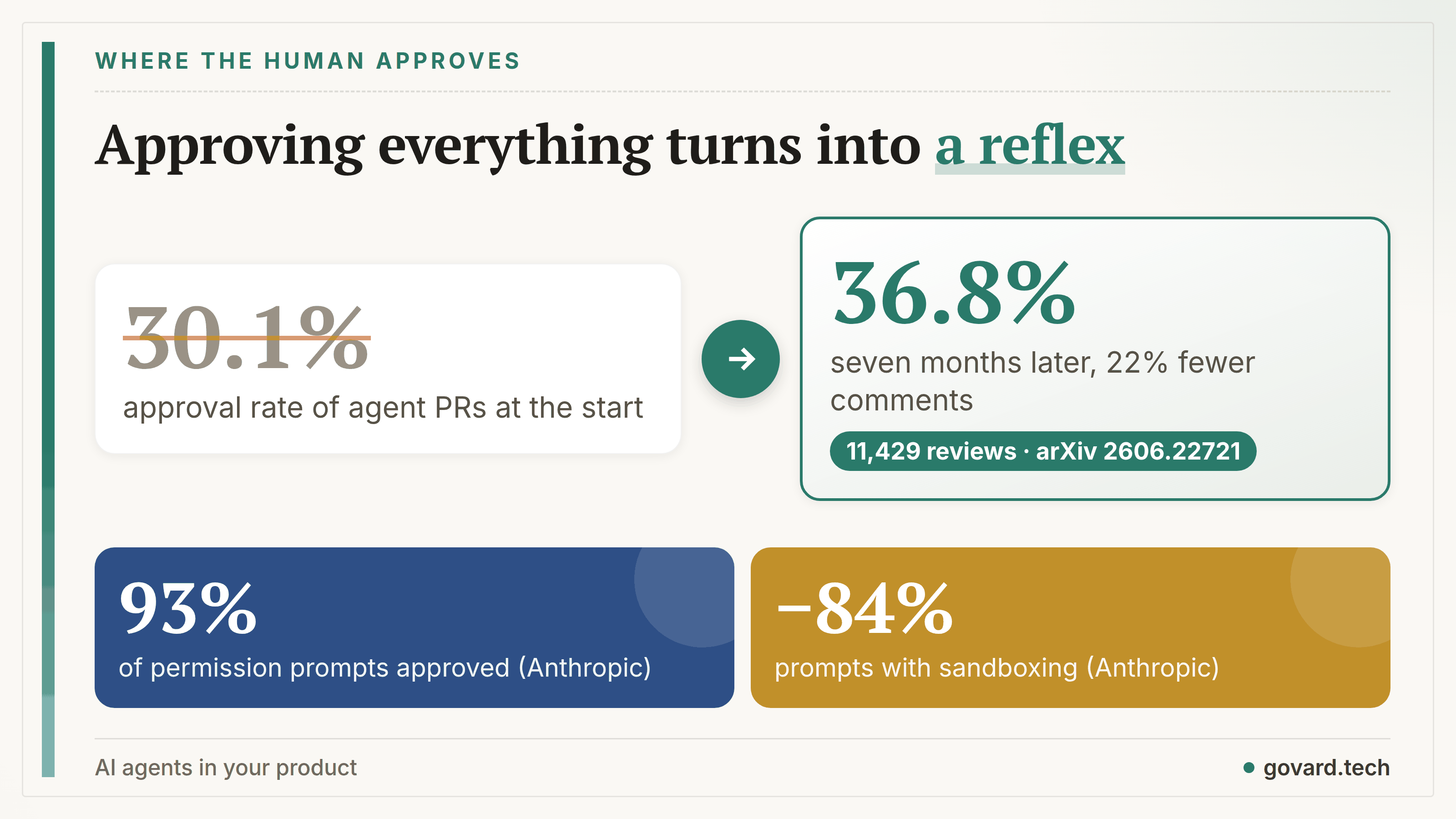
- Anthropic reports that Claude Code users approve 93% of permission prompts. Its engineers call the effect “approval fatigue”, where “users might not pay close attention to what they’re approving”. Sandboxing reduced permission prompts by 84% in their internal use.
- A study of 11,429 reviews of AI-agent pull requests by 400 repeat reviewers found the approval rate rising from 30.1% to 36.8% over seven months, with 22% fewer inline comments. The authors call it “reflexive habituation under growing workload”.
OpenAI’s guide to building agents names two triggers for human oversight: exceeding failure thresholds (retries, actions) and high-risk actions that are “sensitive, irreversible, or have high stakes”, such as canceling orders, authorizing large refunds or making payments.
My read for product teams: let the agent read and draft freely, ask for approval on outbound and financial actions, and show the approval request with enough context to say no.
08 · A checklist before you ship an agent feature
Save this list and run it before each agent release. Each line is a yes or no.
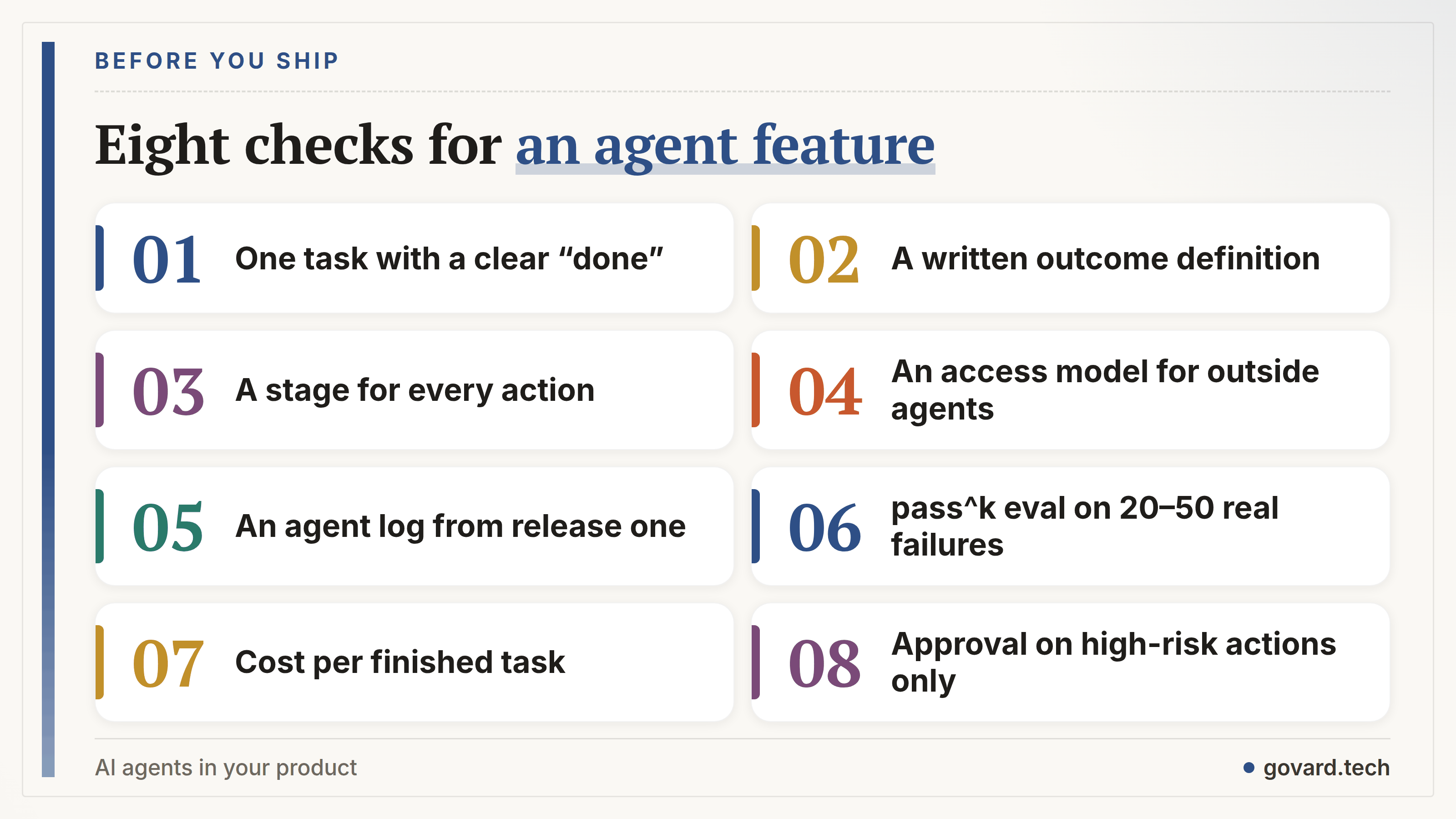
- One task with a clear “done”. You can name the task and the state that counts as finished.
- A written definition of the outcome. It covers confirmation, repeat requests and handoffs to a human.
- A stage per action. For every action you know whether it is answer, act, automate or audit, and which ones need approval.
- An access model for outside agents. Roles, the narrowest starting level and a way to revoke access.
- An agent log from the first release. Every action, the account it ran under, the result.
- A pass^k eval on 20–50 real failures. Run it before each model or prompt change.
- Cost per finished task. Tokens, retries and human review, compared with the price per outcome.
- Approval on high-risk actions only. Outbound messages, payments, deletions, access changes.
My rule of thumb: if three or more lines are “no”, the agent is still a demo. If all eight are “yes”, you can price it per outcome.
Which of the eight is the hardest in your product today?
FAQ
What is outcome-based pricing for AI agents? The customer pays per finished task, such as a resolved conversation. HubSpot charges $0.50 per resolved conversation, Intercom charges $0.99 per outcome for Fin. It needs a definition of a resolved case that both sides accept.
How should a product team roll out an AI agent? In stages, one capability per release: answer questions over product data, take actions, run multi-step workflows, then give users an audit log. Attio followed this order between February and September 2026.
What is MCP and why does it matter for SaaS products? Model Context Protocol lets outside AI agents work with a product’s data and actions. Salesforce, HubSpot and T-Bank ship MCP servers where the agent acts with the rights of the user who connected it.
How do you measure whether an AI agent is reliable? Run the same tasks several times and track how often all runs succeed (pass^k) next to single-run success (pass@1). On 507 workflows Claude Opus 5 scored 66.5% pass@1 but 47.5% pass^20.
Where should a human approve the agent’s actions? On high-risk, irreversible or financial actions and after repeated failures. Approving every step causes approval fatigue: Anthropic reports that users approve 93% of permission prompts.
Related: 64% of venture money now goes to AI, on how per-seat SaaS got repriced in 2026.