govard.
Discuss a project
Massive UI Framework & Engine

HTML-Tailwind Builder

Atomic UI production base

Library Init atomic_core.json
Context
SYS>HTML-Tailwind Builder shows how atomic Tailwind UI production becomes a working production system with clear responsibilities, constraints, and evidence.
Role
USR>UI Systems Architect / Core Engine Builder
Problem
ERR>The core problem is avoiding one-off AI output and keeping the workflow traceable, reviewable and production-oriented.
Goals and tasks
  • ■ Documents how cards, sections, controls, and layouts can be combined without breaking the design system.
  • ■ Gives agents stable component patterns for generating pages without inventing visual systems each time.
  • ■ Uses the library as a bridge between design-system discipline and high-speed landing-page production.
  • ■ Packages Tailwind components as reusable primitives with explicit layout and token contracts.
Quality pass

Connects atomic components to page assembly rules so variants remain consistent across routes.

Level 01

Architecture view

Keeps utility classes, design tokens, and component slots inspectable for AI-assisted generation.
Level 02

Architecture view

Turns the UI library into a controlled production layer instead of a loose collection of snippets.
Level 03

Evolution block

Supports fast composition while preserving spacing, hierarchy, responsive behavior, and reuse boundaries.
Level 04

Server contract

Documents how cards, sections, controls, and layouts can be combined without breaking the design system.
Level 05

Quality pass

Gives agents stable component patterns for generating pages without inventing visual systems each time.

System architecture

HTML-Tailwind Builder demonstrates a scalable Tailwind UI library and atomic component engine through a reusable UI production layer for fast, consistent page assembly.

flowchart TD
 classDef huidInput fill:#050b14,stroke:#00f0ff,stroke-width:1px,color:#00f0ff,font-family:monospace
 classDef huidCore fill:#0a1929,stroke:#00ff9d,stroke-width:2px,color:#ffffff,font-family:monospace
 classDef huidBuilder fill:#120524,stroke:#b200ff,stroke-width:1px,color:#e0c3fc,font-family:monospace
 classDef huidAtomic fill:#1c2105,stroke:#e5ff00,stroke-width:1px,color:#fcffc2,font-family:monospace
 
 subgraph Input ["Data & Registry"]
 JSON[JSON Configs]:::huidInput
 TPL[HBS Templates]:::huidInput
 REG[Component Registry]:::huidInput
 end

 subgraph Engine ["Generation Engine (Node.js)"]
 HBS[Handlebars Core]:::huidCore
 VAR[Variation Engine]:::huidCore
 EXP[Express Server]:::huidCore
 end

 subgraph Builders ["Interactive Constructors"]
 AB[Atom Builder]:::huidBuilder
 MB[Molecule Builder]:::huidBuilder
 SB[Section Builder]:::huidBuilder
 end

 subgraph Atomic ["Output Pipeline"]
 A[Atoms]:::huidAtomic
 M[Molecules]:::huidAtomic
 O[Organisms]:::huidAtomic
 S[Sections]:::huidAtomic
 P[Pages]:::huidAtomic
 end

 JSON --> REG
 TPL --> REG
 
 REG --> HBS
 VAR -.-> HBS
 
 HBS --> EXP
 
 EXP <--> Builders
 
 AB --> A
 MB --> M
 SB --> S
 
 A --> M
 M --> O
 O --> S
 S --> P
Data & Engine Interactive Builders 5-Level Atomic Design
Node.js Core & Component Registries

Uses the library as a bridge between design-system discipline and high-speed landing-page production.

GenerationEngine (Handlebars)

Packages Tailwind components as reusable primitives with explicit layout and token contracts.

AtomicDesignSystem

Connects atomic components to page assembly rules so variants remain consistent across routes.

VariationEngine

Keeps utility classes, design tokens, and component slots inspectable for AI-assisted generation.

ConfigManager

Turns the UI library into a controlled production layer instead of a loose collection of snippets.

Express Preview Server

Supports fast composition while preserving spacing, hierarchy, responsive behavior, and reuse boundaries.

4 builders

A complete set of specialized tools for Atomic Design levels and interface-generation control.
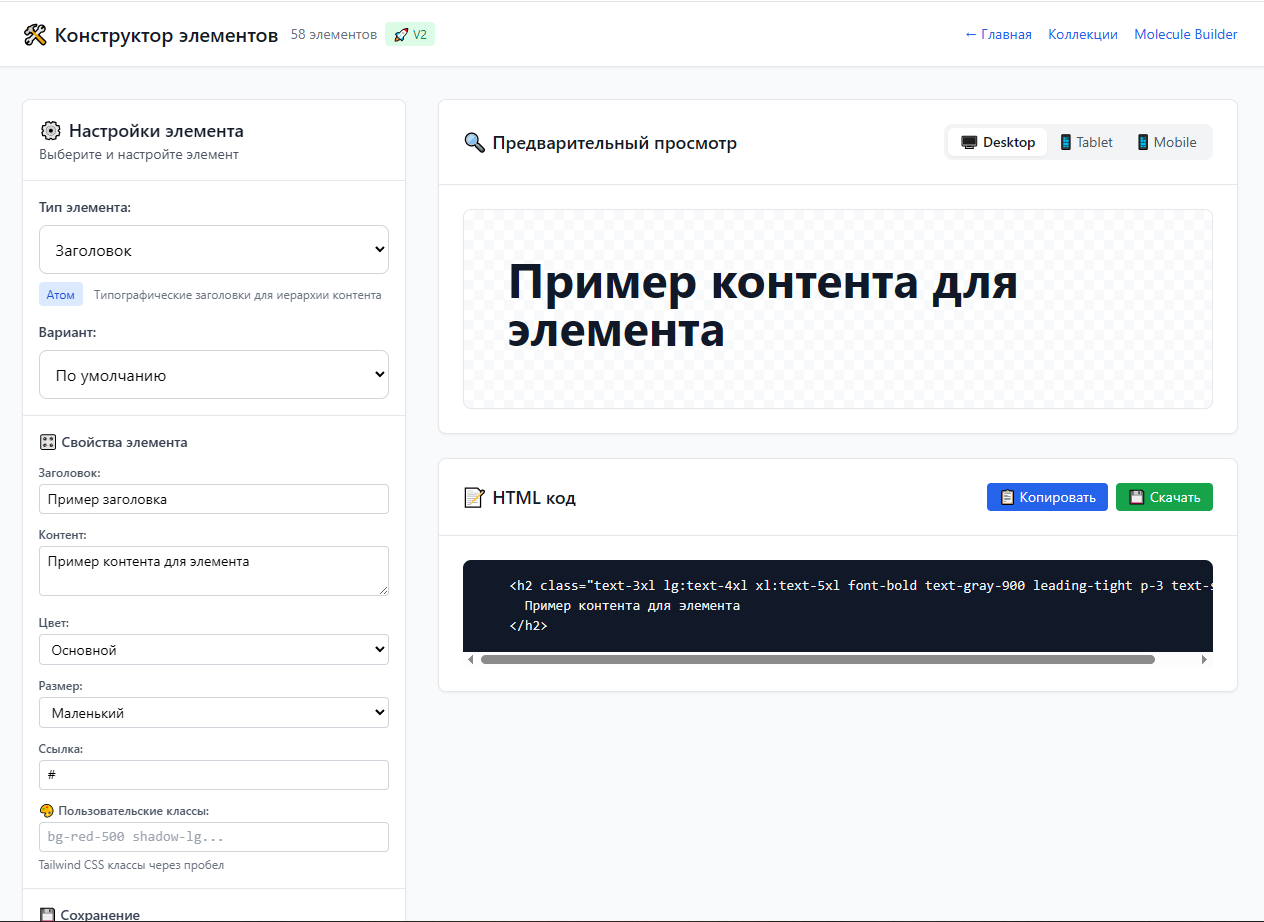
html-tailwind-v0-3-builder.png
Component atom
Level 1

Component atom

Documents how cards, sections, controls, and layouts can be combined without breaking the design system.

Technical specification
Key capabilities
Gives agents stable component patterns for generating pages without inventing visual systems each time. Uses the library as a bridge between design-system discipline and high-speed landing-page production. Packages Tailwind components as reusable primitives with explicit layout and token contracts.
Architecture Layer: Atomic Core
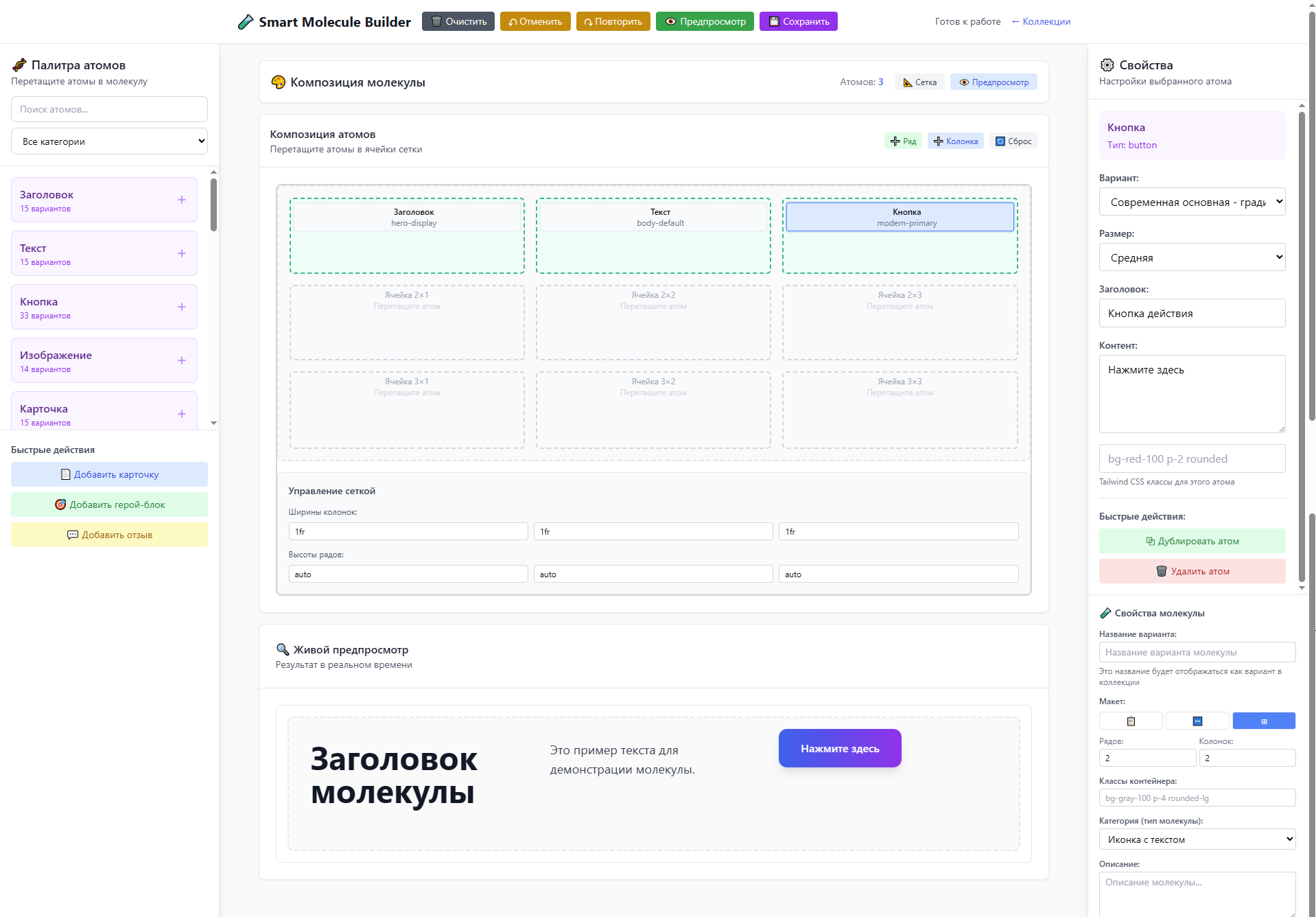
html-tailwind-v0-3-molecule-builder3.png
Component atom
Level 2

Component atom

Connects atomic components to page assembly rules so variants remain consistent across routes.

Technical specification
Key capabilities
Keeps utility classes, design tokens, and component slots inspectable for AI-assisted generation. JSON Data Mapping Turns the UI library into a controlled production layer instead of a loose collection of snippets.
Architecture Layer: Micro-Composition
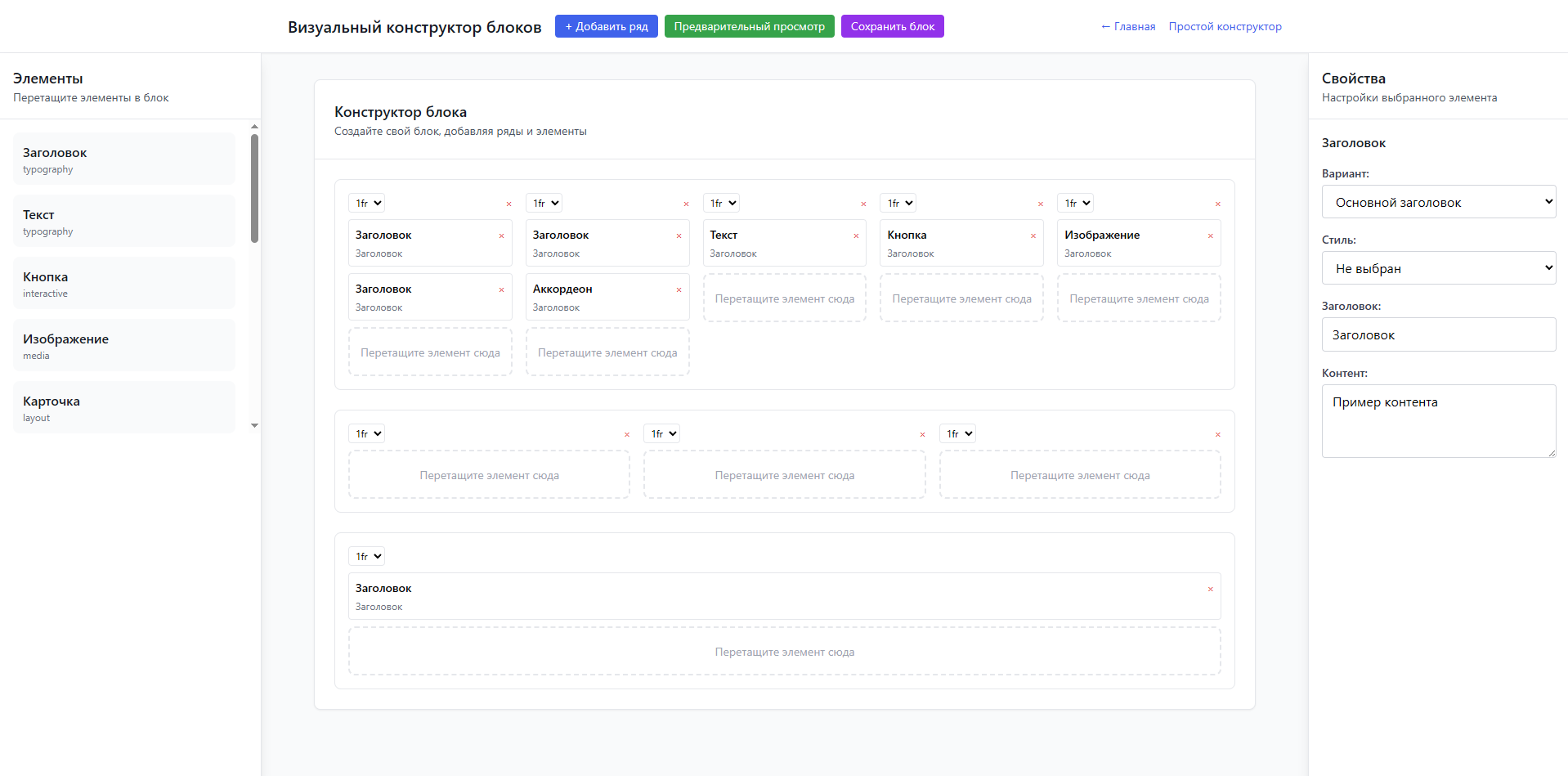
html-tailwind-v0-2-visual-builder.png
Atomic primitive
Level 4

Atomic primitive

Supports fast composition while preserving spacing, hierarchy, responsive behavior, and reuse boundaries.

Technical specification
Key capabilities
Documents how cards, sections, controls, and layouts can be combined without breaking the design system. Variation Engine Gives agents stable component patterns for generating pages without inventing visual systems each time.
Architecture Layer: Macro-Composition
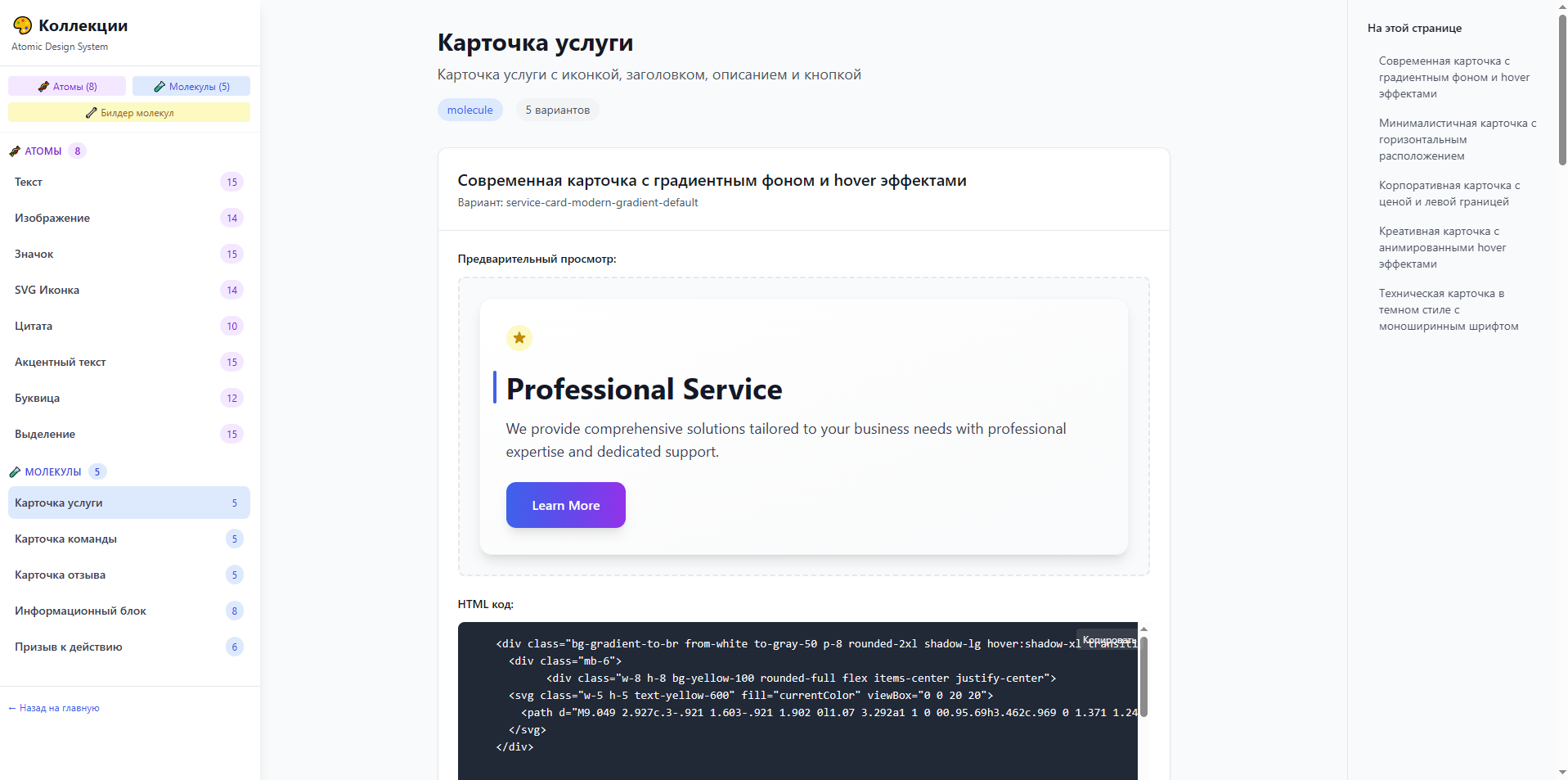
html-tailwind-v0-3-collections-service-cards.png
Dynamic Preview & Validation Server
Ecosystem Core

Dynamic Preview & Validation Server

Uses the library as a bridge between design-system discipline and high-speed landing-page production.

Technical specification

Key capabilities
Packages Tailwind components as reusable primitives with explicit layout and token contracts. JS Execution Connects atomic components to page assembly rules so variants remain consistent across routes.
Architecture Layer: Validation

Atomic component

01

Evolution block

Connects atomic components to page assembly rules so variants remain consistent across routes.
02

Quality pass

Keeps utility classes, design tokens, and component slots inspectable for AI-assisted generation.
03

Evolution block

Turns the UI library into a controlled production layer instead of a loose collection of snippets.
04

Architecture view

Supports fast composition while preserving spacing, hierarchy, responsive behavior, and reuse boundaries.
Project Conclusion

What this proves

Tailwind contract

Documents how cards, sections, controls, and layouts can be combined without breaking the design system.

Pattern library

Gives agents stable component patterns for generating pages without inventing visual systems each time.

Server contract

Uses the library as a bridge between design-system discipline and high-speed landing-page production.

Assembly flow

Packages Tailwind components as reusable primitives with explicit layout and token contracts.

Use the same approach for production systems that need AI acceleration without losing control.

Want a reusable UI production layer instead of scattered components?

I can help structure Tailwind components, atomic blocks, and assembly workflows so AI-assisted production stays consistent and reviewable.